
Northumbria University’s vision for 2030 is that we will enable people from all backgrounds to succeed through our world-leading research and transformative education. EDI is a key part of our University Strategy as a core commitment in our continued journey of excellence. One of our five strategic commitments is to promote fairness in a community where all staff and students feel they belong. By understanding the needs of individuals, we aim to remove any unnecessary barriers for staff and students, adopting an inclusive approach across all our activities, so that everyone can achieve their ambitions.
Our strategic commitment to fairness and belonging informs our approach to our people, including each stage of the colleague and student journey from recruitment to retention, development, and progression. We aim to have a diverse workforce, including more colleagues from under-represented groups at middle and senior management levels. We have committed to the elimination of median pay gaps by gender, ethnicity and disability as our key measurement of success.
Our Access and Participation Plan (APP), approved by the Office for Students, sets out our ambitions for equity, diversity and inclusivity in the make-up of our student body and how we support our students to complete and succeed in their studies, creating the conditions for success after they graduate.
Our annual delivery plan for EDI in relation to our colleagues right across the organisation enables us to coordinate activity, ensure focus and plan EDI related events and activities.
Our EDI report covers the academic year of September 2024 to August 2025. Throughout the year the University has continued to progress work relating to our four focus areas of inclusion which are Gender, Race, LGBTQ+ and Disability Equality.
To support a structured and intersectional institutional approach to EDI which will enable us to advance equality beyond the four focus areas, the University has continued to make progress in relation to its three core EDI themes. These are to:
- Embed EDI into our core business
- Take action to eliminate barriers
- Foster inclusion and a sense of belonging
This report provides a summary of the actions taken, and progress made against our 2024 – 2026 Equality Objectives. The report also provides an update in relation to our colleague demographics, which is part of our commitment to transparency and enables us to fulfil our requirement to publish regular information under the Public Sector Equality Duty.
Leadership, Structures and Governance
The EDI Committee, chaired by Professor Andy Long, the Vice-Chancellor and Chief Executive of Northumbria University, has responsibility for overseeing EDI and is accountable to the Board of Governors. Each focus area of inclusion is led by a Senior Sponsor, who is part of the University’s Senior Leadership Team ensuring accountability for EDI matters at the highest level within the organisation.
During the reporting period, Faculty-level strategic responsibility for EDI sat with Deputy Faculty Pro Vice-Chancellors (Research and Knowledge Exchange), supported by Faculty Directors of EDI to ensure EDI was firmly embedded into management structures and decision-making processes.
Governance and Structure Changes for the Academic Year 2025-26
A restructure of Faculties provided an opportunity to review the existing EDI model and establish a governance structure with greater clarity of EDI roles, supporting more cohesive working with the central EDI team and aligned to strategy. Faculty Pro Vice-Chancellors will assume strategic responsibility for EDI, chairing an EDI Operational Group which will oversee and operationalise all aspects of EDI including Faculty Athena Swan work.
From September 2025 academic Departments will become Schools under the new Faculty structure and planning is underway to transition the existing departmental Athena Swan awards to three Faculty awards.
Steering Groups, chaired by our Senior Sponsors, will become Equality Forums which are more discursive in nature to enable wider engagement with those who wish to contribute to the University EDI agenda.
Finally, we have commenced a review of our Colleague Equality Networks to ensure we work more cohesively, ensure parity and improve consultation and involvement. Networks will continue to feed into relevant forums as well as to the central EDI Team.

EDI Team
The EDI Team in People and Organisational Culture, led by the Director of EDI, support work related to the four areas of inclusion, working closely with Senior Sponsors.
Networks and Groups
The University has a range of formal and informal networks and groups which the Equality Steering Groups engage with when appropriate. The co-chairs of formal Networks such as the True Colours (LGBTQ+) Network and the Disabled Staff Network hold seats on the relevant Steering Groups.
Student Life and Wellbeing
The Accessibility and Inclusion Team is a large team within Student Life and Wellbeing covering student accessibility, access to learning funds and student inclusion. Their purpose is to enable all students to access equal opportunities and address inequalities in student outcomes post-entry. Each team has a specific focus such as supporting disabled students; providing financial support to students in hardship; and supporting care leavers, carers and estranged students.
The teams lead or directly support a variety of key legal and regulatory requirements relating to equality, diversity and inclusion for our students. This includes Northumbria’s Access and Participation Plan.
You might also be interested in...
Latest News and Features

Northumbria University research unlocks the secrets of Vivienne Westwood's craft in a major new exhibition
A fashion researcher and educator from Northumbria University has created what is believed…
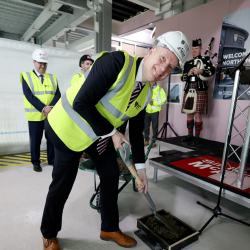
NESST topping out ceremony attendees receive traditional tankards to celebrate build milestone
Topping out ceremony marks pivotal moment for centre backed by £50 million investment set to…

From Netflix to Newcastle Northumbria graduate uses AI to revolutionise film and TV production
A Northumbria University graduate who co-created Bangkok Breaking — one of Thailand's biggest…

Northumbria University researcher brings death-positive arts festival to libraries across England
An arts festival exploring death, dying and end-of-life choices — led by a Northumbria University…
Northumbria University spinout achieves CE marking for deep lung breath sampling device — a first backed by peer-reviewed research
A medical device company spun out of Northumbria University has reached a significant milestone…

Northumbria University's IT recycling initiative recognised as national best practice
The equivalent weight of one and a half double-decker buses' worth of IT equipment has been…
Scientists solve decades-long mystery about why Saturn appears to change its spin
Researchers at Northumbria University have used the most powerful space telescope ever built…

Northumbria University professor named among UK's most outstanding health and care research leaders
A Northumbria University professor has been appointed as one of the UK's most influential health…
More events
Upcoming events

From sustenance to complete nourishment in a changing and uncertain climate
Ellison Building A, 001 (ELA 001)
-

Broken Bonds: New Perspectives on Marital Breakdown
The Great Hall
-

Smarter Supply Chains: Digital Innovation for Cost, Efficiency & Carbon
Northumbria University
-

Culture in Conversation: Rethinking Leadership & Organisational Practice
CCE1 Newcastle Business School
-
