-
Study
-
Quick Links
- Open Days & Events
- Real-World Learning
- Unlock Your Potential
- Tuition Fees, Funding & Scholarships
- Real World Learning
-
Undergraduate
- Application Guides
- UCAS Exhibitions
- Extended Degrees
- School & College Outreach
- Information for Parents
-
Postgraduate
- Application Guide
- Postgraduate Research Degrees
- Flexible Learning
- Change Direction
- Register your Interest
-
Student Life
- Students' Union
- The Hub - Student Blog
- Accommodation
- Northumbria Sport
- Support for Students
-
Learning Experience
- Real-World Learning
- Research-enriched learning
- Graduate Futures
- The Business Clinic
- Study Abroad
-
-
International
International
Northumbria’s global footprint touches every continent across the world, through our global partnerships across 17 institutions in 10 countries, to our 277,000 strong alumni community and 150 recruitment partners – we prepare our students for the challenges of tomorrow. Discover more about how to join Northumbria’s global family or our partnerships.
View our Global Footprint-
Quick Links
- Course Search
- Undergraduate Study
- Postgraduate Study
- Information for Parents
- London Campus
- Northumbria Pathway
- Cost of Living
- Sign up for Information
-
International Students
- Information for International Students
- Northumbria and your Country
- International Events
- Application Guide
- Entry Requirements and Education Country Agents
- Global Offices and Regional Teams
- English Requirements
- English Language Centre
- International student support
- Cost of Living
-
International Fees and Funding
- International Undergraduate Fees
- International Undergraduate Funding
- International Masters Fees
- International Masters Funding
- International Postgraduate Research Fees
- International Postgraduate Research Funding
- Useful Financial Information
-
International Partners
- Agent and Representatives Network
- Global Partnerships
- Global Community
-
International Mobility
- Study Abroad
- Information for Incoming Exchange Students
-
-
Business
Business
The world is changing faster than ever before. The future is there to be won by organisations who find ways to turn today's possibilities into tomorrows competitive edge. In a connected world, collaboration can be the key to success.
More on our Business Services-
Business Quick Links
- Contact Us
- Business Events
- Research and Consultancy
- Education and Training
- Workforce Development Courses
- Join our mailing list
-
Education and Training
- Higher and Degree Apprenticeships
- Continuing Professional Development
- Apprenticeship Fees & Funding
- Apprenticeship FAQs
- How to Develop an Apprentice
- Apprenticeship Vacancies
- Enquire Now
-
Research and Consultancy
- Space
- Energy
- AI and Tech
- CHASE: Centre for Health and Social Equity
- NESST
-
-
Research
Research
Northumbria is a research-rich, business-focused, professional university with a global reputation for academic quality. We conduct ground-breaking research that is responsive to the science & technology, health & well being, economic and social and arts & cultural needs for the communities
Discover more about our Research-
Quick Links
- Research Peaks of Excellence
- Academic Departments
- Research Staff
- Postgraduate Research Studentships
- Research Events
-
Research at Northumbria
- Interdisciplinary Research Themes
- Research Impact
- REF
- Partners and Collaborators
-
Support for Researchers
- Research and Innovation Services Staff
- Researcher Development and Training
- Ethics, Integrity, and Trusted Research
- University Library
- Vice Chancellors Fellows
-
Research Degrees
- Postgraduate Research Overview
- Doctoral Training Partnerships and Centres
- Academic Departments
-
Research Culture
- Research Culture
- Research Culture Action Plan
- Concordats and Commitments
-
-
About Us
-
About Northumbria
- Our Strategy
- Our Staff
- Our Schools
- Place and Partnerships
- Leadership & Governance
- University Services
- Northumbria History
- Contact us
- Online Shop
-
-
Alumni
Alumni
Northumbria University is renowned for the calibre of its business-ready graduates. Our alumni network has over 253,000 graduates based in 178 countries worldwide in a range of sectors, our alumni are making a real impact on the world.
Our Alumni - Work For Us
Disability Pay Gap 2023
View the 2023 pay gap reporting on disability at Northumbria
There is no statutory duty to analyse or report on disability pay, but the University now reports the Disability Pay Gap in line with our commitments to Disability Equality and our role as a Disability Confident Leader organisation. Our reporting of disability pay has been conducted using the same snapshot date as the gender and ethnicity pay gaps and uses the same inclusion criteria. Disabled staff are those employees who have voluntarily recorded in the online HR system that they have a disability, which will be lower than the total number of Disabled staff employed by the University.
The disability pay gap is reported as the difference between non-Disabled staff and Disabled staff, excluding where it is not known whether an employee is Disabled or not. A positive gap indicates a gap in favour of non-Disabled staff. Unlike the further analysis on five groups considered for the ethnicity pay gap, it is not possible to go beyond a comparison of Disabled and non-Disabled employees to look also at gaps by disability type, due to the number of categories, the smaller numbers of employees in each category and low disclosure of disability type. A full breakdown of the data can be found in appendix F.
Disability Pay Gap
| Year | Median % | Mean % |
| 2021 |
13.9 |
7.0 |
| 2022 | 15.8 | 10.6 |
| 2023 | 13.3 | 11.0 |
The proportion of full-pay relevant recorded as Disabled on the snapshot date has increased year on year from 2.5% (79) in 2021 to 3.4% (123) in 2023. This figure differs from the disclosure rate reported in EDI annual reporting, which uses the proportion of salaried employees, excluding employees with variable hours contracts, and uses a different reporting date.
The University continues to hold as a priority the importance of building a culture of trust in which Disabled employees feel comfortable to tell us about their disability. Although the number of Disabled employees is low, the Disability Pay Gap is statistically significant, meaning that it is unlikely that a higher disclosure rate will close the pay gap without understanding the underlying factors that contribute to the pay gap providing key insights to inform targeted action.
![]()
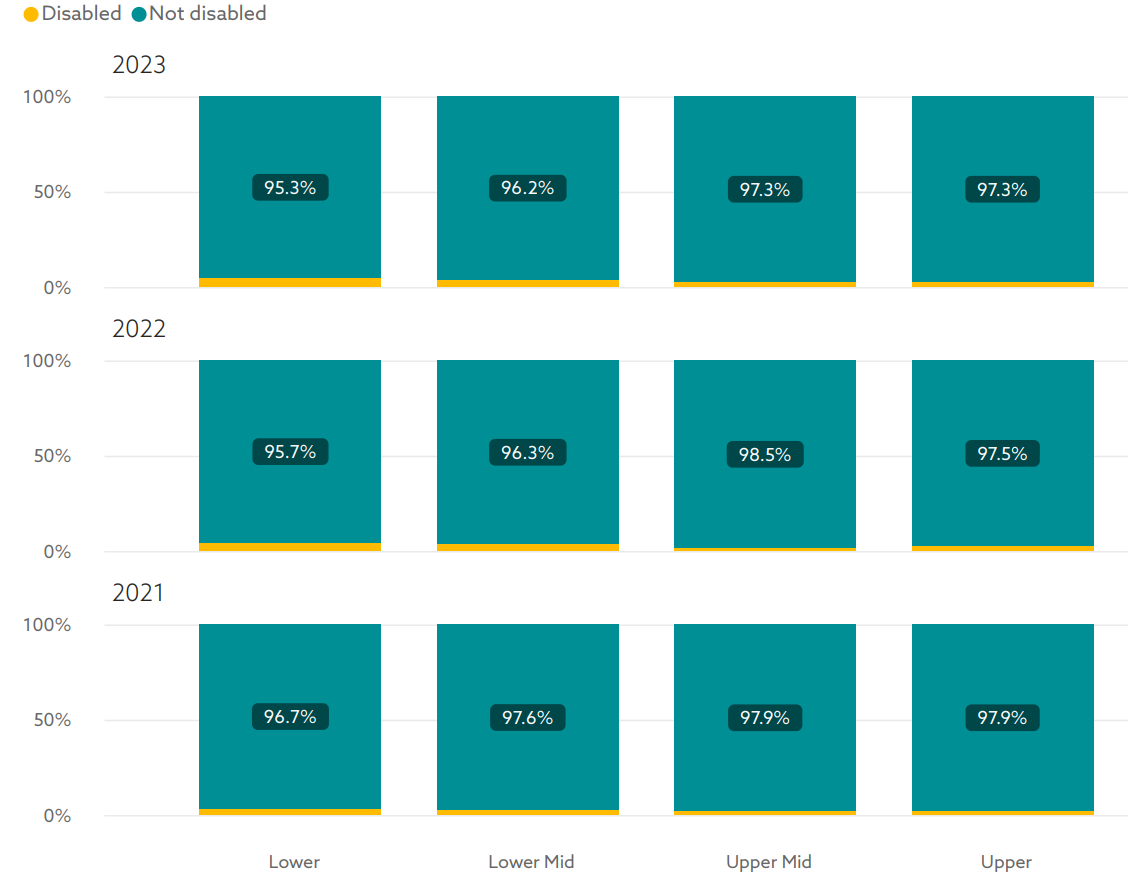
7. Disability Quartiles by Year, 2021 - 2023 (Full-pay equivalent employees, Northumbria University and Northumbria University Services Limited Excludes 'unknown' disability ('prefer not to say' or not recorded)
View the disability pay gap images in an accessible format.
![]()
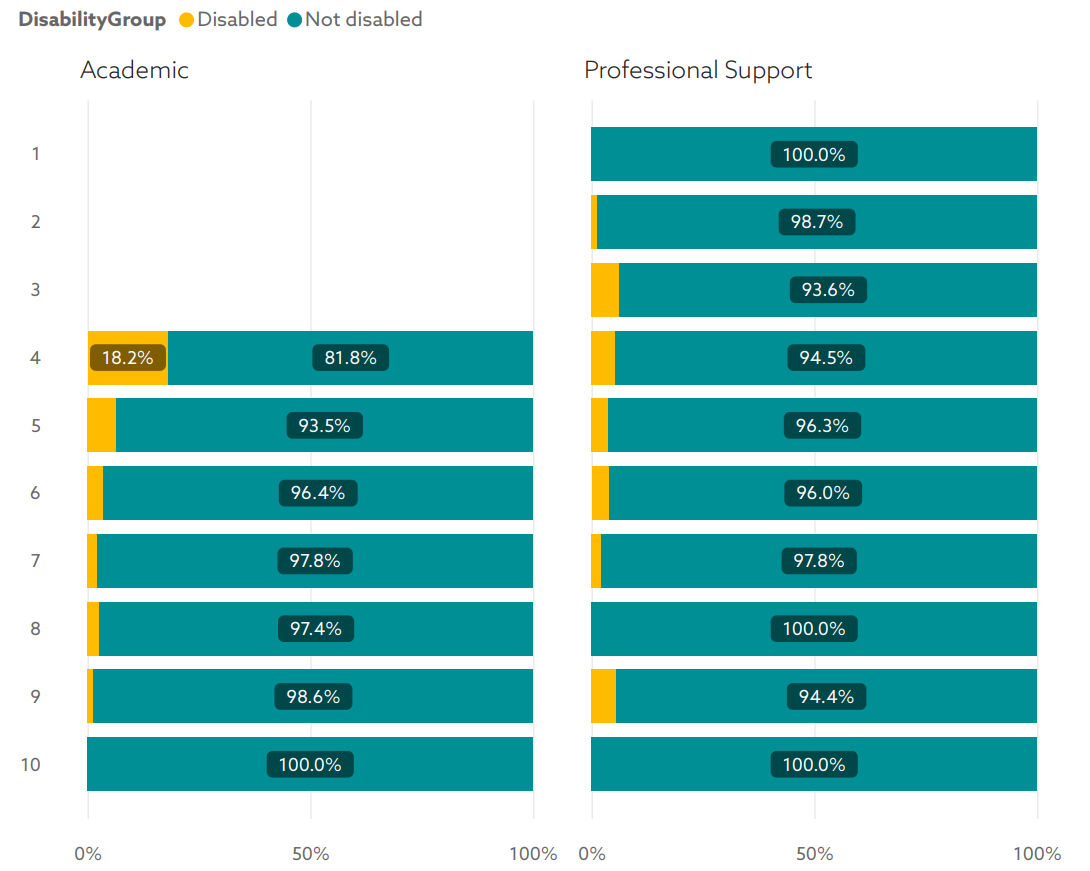
8. Disability by Grade and Employee Type, 2023 (Full-pay equivalent employees, Northumbria University and Northumbria University Services Limited Includes Grades 1 - 10, excluding KTPs and other grades outside the main pay spine. Values <5 are suppressed. Excludes 'unknown' disability ('prefer not to say' or not recorded)
View the disability pay gap images in an accessible format.
The median Disability Pay Gap has decreased from 2022 and there has been an increase of less than a percentage point in the mean gap. The quartiles show little change between 2021 and 2023, with a higher proportion of Disabled employees in the lower and lower middle quartiles than in the upper middle and upper quartiles. While numbers are small (less than 10 for many grades) there is an evident decline in the proportion of Disabled full-pay relevant employees as grade increases. For Academic roles, between Grades 5 and 9 the proportion of Disabled employees reduces from 6.5% to 1.4%, and for Professional Support roles the proportion reduces from 6.4% at Grade 3 to 2.2% at Grade 7. However, the small numbers of Disabled employees in each group when split by type of role and grade makes it difficult to draw conclusions from changes in the distribution of Disabled employees through grades.
Return to Main Pay Gap Reporting page.
