
Alister Scott, Professor of Environmental Geography and an expert in urban planning and infrastructure, writes for The Conversation on proposals to change the UK's planning system.
“Rip up planning red tape to spur house building,” says housing secretary Robert Jenrick, while Prime Minister Boris Johnson argues for a radical shake-up to the planning system to deliver on his “build build build” mantra. There’s a clear political message that England’s planning system is broken and needs change.
Such change should not be based on simply building more, but on an accurate diagnosis of the problems the planning system is experiencing and trying to solve. If it isn’t, there is a risk of a future prime minister saying again that the planning system is broken and in need of urgent reform.
After all, David Cameron in 2011 attacked the planning system as “the enemy of enterprise” and similarly embarked on a package of reforms to speed up housing delivery and economic growth and cut red tape. Yet consistently over 80% of planning applications are approved, challenging any simplistic presumptions that planning inhibits growth.
Political change has been a constant in England’s planning system. Since the landmark 1947 Town and Country Planning Act, some 360 pieces of planning legislation have been enacted. What’s more, since 1997 there have been 18 housing ministers, hindering policy consistency.
Managing change has been made more difficult with significant cuts to planning departments under austerity, compounded by incremental legislative changes that create the very complexity and delays that the government now complains about.
Today, calls for reform have been fuelled by a report by the right-wing thinktank Policy Exchange. With the country needing to build many more houses, the argument goes that replacing our plan-led system that assesses every application with a zoning system would reduce bureaucracy and help speed up decision-making.
There have already been some moves in this direction, with enterprise zones and brownfield “permission in principle” orders. Permitted development rights have enabled the government to fast-track more commercial-to-residential developments and housing extensions. Boris Johnson has just announced further loosening of the rules on converting other commercial establishments, shops and redundant premises into homes.
But these changes have already been criticised due to the growth of poor quality houses and flats with no windows, isolated from key services and infrastructure. Such homes would never have been given approval in the regular planning system, and also conflict with other policy considerations such as those of the advisory Building Better, Building Beautiful Commission.
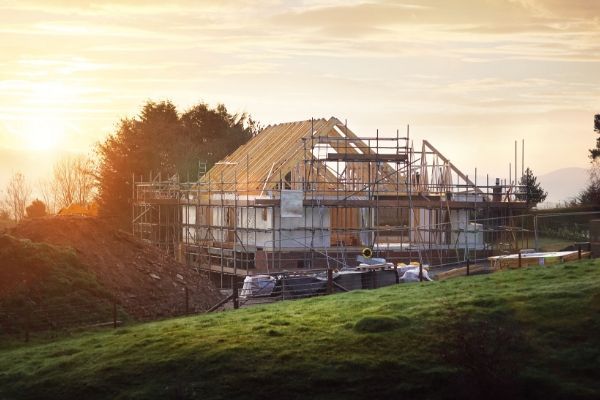
Diagnosing the planning challenges
“Build build build” is the wrong starting point. Planning is dominated by a target of building 300,000 homes each year, and the prime minister’s rhetoric reinforces that narrative. But one simple quantity metric on housing is dangerous and limiting when planning encompasses so much more.
The planning system should instead be designed to address the long-term challenges and opportunities our society faces. And that means a more integrated quality-based approach based on a shared vision of the kind of places we want to live in. Let’s identify these challenges in more detail:
- There is a housing challenge. Plenty of luxury flats are built but not enough affordable family homes. The key national priorities do not match the types of housing now being built and wanted by developers.
- There is a climate challenge. We are not doing anything like enough to meet the 1.5℃ Paris target, with 3℃ or more of warming now more likely. The planning system needs to have strong policies that help the transition to a greener lower carbon future with higher priority given to retrofitting of existing housing stock.
- There is a biodiversity challenge. The state of UK nature is declining year on year with many species on the brink of extinction. Biodiversity forms the backbone of viable ecosystems on which we depend on for basic necessities, security and health. This diversity makes us more resilient to change and uncertainty in much the same way as investing in a diverse range of stocks protects a financial portfolio from uncertainty.
- There is a health challenge. Poor housing stock and noise and air pollution, along with a lack of access to key services, all affect physical and mental health.
- There is a poverty and social justice challenge. The gap between the haves and have-nots is widening. Here child poverty is a major issue. The planning system was founded on the need for improved social justice, yet in recent years this has been conspicuously absent from policy.
- There is a public engagement challenge. Ordinary people should be able to understand and engage with planning more effectively and help co-produce the kinds of sustainable places they want to live, work and play in. The current system is too complex and too adversarial. A key opportunity is for the public to be more involved in planning processes which should be based on modern interactive “e-planning” and not dense and static PDF files.
These challenges are all interlinked and collectively should form the key principles on which a better and more joined-up planning system should be built. However, what that planning system looks like is not for me or anyone to dictate in a top-down fashion. We urgently need better diagnoses of these challenges and integrated interventions, so that then we can then design better governance and delivery frameworks that are less complex and fragmented.
I fear that the government will continue on its present trajectory, based on the populist but fallacious presumption that planning is restricting housebuilding, and impose yet more change on a public sector ill-equipped to deal with it. In effect, the country lurches from one crisis to another. And that is definitely not good planning.
Professor Scott is based in the Department of Geography and Environmental Sciences at Northumbria University. This article was originally published by The Conversation.

Geography At Northumbria University Encompasses All Of Our Work In Physical And Human Geography, Environmental Science And Management, Health & Safety, And Disaster Management.
This is the place to find all the latest news releases, feature articles, expert comment, and video and audio clips from Northumbria University
Geography At Northumbria University Encompasses All Of Our Work In Physical And Human Geography, Environmental Science And Management, Health & Safety, And Disaster Management.
This is the place to find all the latest news releases, feature articles, expert comment, and video and audio clips from Northumbria University
Latest News and Features

Speeding glaciers drive half a century of polar ice loss
The longest satellite record ever assembled shows that Greenland and Antarctica have lost 11.3…

Northumbria physicist elected Fellow of the Institute of Physics
Dr Juna Sathian, an Associate Professor at Northumbria University, has been elected a Fellow…

Northumbria helps shape national plan to boost graduate employability
Northumbria University has played a key role in shaping a new national plan designed to help…

Northumbria researcher joins appeal to Downing Street on free school meals and holiday support
A Northumbria University academic, whose research has played a key role in bringing breakfast…

Ancient wildfires near the South Pole shaped Earth's earliest peat bog
Wildfires raging through prehistoric rainforests helped create the earliest known peat bog…

Northumbria astronomer helps reveal secrets of rare interstellar visitor
A Northumbria University astronomer has helped uncover new clues about a rare icy object from…

Two Northumbria professors elected Fellows of the Academy of Social Sciences
Two leading academics from Northumbria University have been elected to the Fellowship of the…

New scientific review involving Northumbria researchers identifies Antarctic coastal blind spots limiting sea level projections
A new international, community-led, scientific review warns that major gaps in knowledge along…
More events
Upcoming events


IPE Conference 2026
Northumbria University
-

Specialist Teaching Assistant Degree Apprenticeship - In-person Information Session
Coach Lane Campus
-

Next Stop Northumbria
Europa Hotel
-
