
The world is facing an unprecedented energy challenge. While many countries around the world have committed to net-zero carbon emissions by 2050, we expect global energy for demand to double from today’s requirements within the same timescale. There is, therefore, an urgent need for sustainable solutions and technologies.
To help meet this need, Energy Futures - a diverse and inclusive community of over 50 academics from across various departments at Northumbria University – is driving forward innovative research-driven approaches to create a cleaner energy future for all. Energy Futures encompasses high-quality research spanning photovoltaics, thin film materials, batteries, materials characterisation, electrical power engineering, heat, sustainable design, and the built environment.
As part of our work to shine a light on climate-related research from Northumbria in the run-up to COP26 we asked Dr Lucy Whalley, Vice-Chancellor’s Fellow from Northumbria's Department of Mathematics, Physics and Electrical Engineering, to tell us about her research in developing new energy technologies.
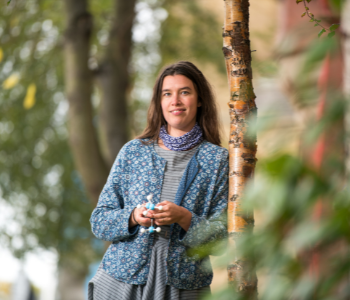
While many people use green energy sources to power their homes these sources can often be intermittent due to the weather, which means they might not always deliver electricity or heating when needed. But what if there were more efficient ways to generate and store this renewable energy?
Dr Lucy Whalley is leading research into identifying materials which will improve the light-to-electricity efficiency of solar cells, and increase the amount of energy that can be stored by rechargeable batteries.
Tell us about your area of research
I specialise in computational materials science which is a combination of physics, chemistry and software engineering. I use techniques from these fields, alongside high-performance-computing (supercomputers) to investigate why certain materials perform particularly well when integrated into energy technologies. For example, why is that some materials can efficiently generate energy from sunlight? And can we engineer new materials which will make even more efficient solar cells?
What led to your interest in this particular field of research?
Both of my parents are very socially minded. My father was a nurse and my mum worked in welfare rights so I always felt, like them, I wanted to contribute and give something back to society.
My degree was an MSci in Theoretical Physics, with particular emphasis on a branch of theory called condensed matter. I loved it but wasn’t clear how I could convert my passion into helping answer some of society’s most immediate questions.
After spending time as a maths teacher, I recognised that within the field of photovoltaics - which includes solar cell materials - there is an overlap between the challenge of climate change and condensed matter physics and this provided a clear direction and renewed focus for me. I knew I wanted to concentrate on addressing the challenge of achieving net zero.
I went on to study a PhD at Imperial College London, as part of the Centre for Doctoral Training in new and sustainable photovoltaics and following a very brief spell as a postdoctoral researcher came to Northumbria University in my current role.
What do you ultimately hope to achieve?
Batteries are a critical piece of the jigsaw in our journey towards net zero. Green energy sources such as wind power or solar energy are intermittent so any energy generated needs to be stored efficiently for future use when it’s needed. After all, you can’t expect people to wait for their cup of tea until it’s windy or sunny outside.
My experiments are done on a computer and look at a very basic level of how individual atoms and electrons combine in particular ways. It’s a quick way of identifying materials which might improve the efficiency of solar cells or the storage capacity of batteries and can be used to guide the work of my colleagues who make the materials.
For example, lithium chemistry is the standard technology used for batteries in electric cars but we are currently researching magnesium to see if it could provide a possible alternative.
The predicted energy density is greater in magnesium batteries than lithium so, if the technology is viable, it could increase the range of a single charge and make electric cars more attractive to buyers. This could also be an important consideration when looking at how we deal with transporting freight in the future.
Ultimately, being able to see some of the materials I’m working on now being produced and used in real life applications that will make a positive difference to climate change within my lifetime would make me extremely happy.
What has been your biggest achievement in research to date, and why?
During my PhD I developed a piece of software called effmass, which calculates the effective mass of an electron for a given material. The effective mass is a mathematical simplification which allows us to reduce all of the complex interactions between the electron and the material it is moving through into a much simpler picture – an electron in empty space with an adjusted mass. We call it an effective mass to distinguish it from the electron rest mass, which doesn’t change between different materials.
I’m extremely proud of this software as developing it was a real learning curve – I had to translate my code from something quite unreadable and unusable into something that other scientists would use. Despite it being quite domain specific it has been downloaded more than 14,000 times, which underlines its usefulness to the academic community.
This touches on the topic of software sustainability, which is a topic I advocate strongly for. It is a huge waste of time and resources to reinvent the wheel writing the same piece of code again and again instead of sharing our code as a community. I take care to ensure my software is tested and documented so that it can be used by other researchers.
Who or what inspires you?
I’m inspired by the people who put their lives on the line for the Net Zero target.
I love working in this sector, but I recognise that I am well rewarded for my work. As well as a regular salary, I receive recognition and support from the scientific community and wider society.
But tackling climate change is not just about developing new technologies. Science can only take us so far – we also need a fundamental cultural change. We need people to embrace and adopt new technologies and we need governments to help finance and support these new technologies to help us achieve net zero. Only by everyone contributing and working together can we make a real difference and address this global problem head on.
There are people out there who recognise this and want to make a difference but face much greater criticism than the scientists or engineers. People like Greta Thunberg and Leah Namugerwa, who are putting enormous pressure on governments across the world to mitigate against climate change, but who have also received a substantial backlash of criticism from certain quarters. They carry on anyway and it’s this spirit of determination that I admire, and which inspires me to carry on with my own work.
Where have you worked before and what attracted you to Northumbria?
Prior to coming to Northumbria University, I spent a number of years in academia studying material science. I also spent some time working as a maths teacher.
Northumbria has an incredibly strong relationship with industry and works closely with employers so that its research has more impact on the critical problems facing the world today. The university takes a wide-ranging approach to research, covering the initial stages of development right through to the industrial application. This approach appeals to my desire to make a more immediate difference and very much attracted me to my current role.
As someone who grew up in North Tyneside, I’m very proud that the North East is at the centre of the green revolution and there is an enormous amount of development going into low carbon technologies across the region. Being at the centre of this drive and developing new materials to support the renewables energy as it grows is very exciting. I am delighted to now be working at Northumbria University, helping to shape the future in renewable energy technologies.
Find out more about how Northumbria academics are championing a net zero future with the energy of tomorrow on our Energy Futures webpages.
Department of Mathematics, Physics and Electrical Engineering
This department encompasses all of our work in Mathematics, Statistics and Physics including Astrophysics, Electrical and Electronic Engineering, Energy, Smart Materials, Microelectronics and Communications.


This is the place to find all the latest news releases, feature articles, expert comment, and video and audio clips from Northumbria University
Latest News and Features
UK network to accelerate the development of sustainable surface technologies
A new national network led by Newcastle University and Northumbria University, in partnership…

Criminologist wins acclaimed Philip Leverhulme Prize to pioneer a new criminology of the offshore world
A Northumbria University criminologist has been awarded a Philip Leverhulme Prize, one of the…

New platform maps charity support for the Armed Forces community
Pioneering data platform maps where the Armed Forces community receive support from charities

Northumbria co-leads study on fairer support for families
A major study co-led by Northumbria University will test whether attachment assessments lead…

New AHRC research shows how community innovation can power the next phase of devolution.
New research published today by the AHRC Creative Communities programme provides fresh evidence…

Free sessions to help families navigate the SEND system
Northumbria University's award-winning Student Law Office is launching SEND Decoded, a series…

New Doctoral Training Programme will tackle key polar science questions with a reduced carbon footprint
The Net Zero Polar Science (NZPS) Doctoral Training Programme (DTP) has welcomed its first…

New Student Health Hub brings joint health and wellbeing support
A new drop-in service is bringing health and wellbeing support for students at both Newcastle…
More events
Upcoming events

Next Stop Northumbria
Manchester Marriott Hotel Piccadilly
-

-
Magnetospheric Multiscale Science Working Team Meeting
Sutherland Building

Christmas Market and Tree lighting
Northumbria University
-
