
Researchers from Northumbria University in Newcastle, and Bogazici University in Turkey, have discovered a new way of examining the structure and dynamics of single protein molecules within the human body – which could help scientists better understand the progression and possible treatment of diseases such as cancer.
The team, led by Dr Hamdi Torun, used a technique known as atomic force microscopy which allowed them to identify a single protein molecule within a sample of millions and investigate how it behaved when combined with other molecules.
They combined this technique with a computational investigation led by Professor Turkan Haliloglu, which allows scientists to develop models and simulations-based data – in this case predicting how a molecule might react and mutate following biochemical changes and how this might affect the progression of a disease.
Being able to identify such mutations would allow scientists to understand mutation-led diseases such as cancer and cystic fibrosis, as well as design more effective drugs to treat or vaccinate against these diseases, and even Covid-19 in the future.
Speaking about the research, Dr Torun said: “This is the first time that these two techniques of experimental investigation and computational investigation have been combined to examine a specific protein molecule.
“Isolating one particular molecule in this way is not common practice, but it is the most effective way to probe the structure of the molecule and ask questions such as ‘what if I change a specific part of the protein?’ or ‘what if I attach a specific enzyme to the protein?’
“It is the answers to these questions which will allow us to then design new drugs to treat diseases such as cancer, potentially making a huge difference to people’s lives.”
The research has been published in the Biophysical Journal in a paper entitled Oncogenic mutations on Rac1 affect global intrinsic dynamics underlying GTP and PAK1 binding.
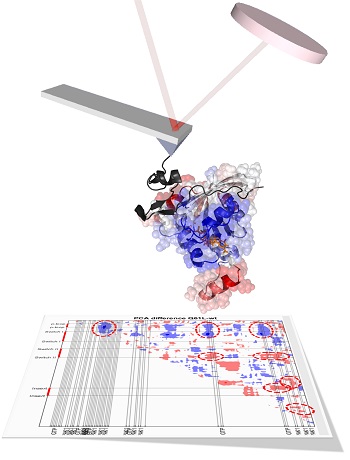 An image depicting the results of their
computational investigation was also selected to appear on the front cover ofthe journal (volume 120, issue 5).
An image depicting the results of their
computational investigation was also selected to appear on the front cover ofthe journal (volume 120, issue 5).
The research project, entitled Force and Function in Biological Macromolecules: Molecular Simulation and Single-Molecule Studies, was funded by the Scientific and Technological Research Council of Turkey (TUBİTAK).
Speaking about the potential to use this technique more widely Dr Torun said: “For this study we chose to investigate a protein which is available in all human cells, but the technique could be applied to any protein, for example the spike protein found in Coronavirus.
“This research has huge potential for application, and we hope it will lead to new breakthroughs in the treatment of diseases in the future.”
Find out more about Northumbria University’s Department of Mathematics, Physics and Electrical Engineering.
Department of Mathematics, Physics and Electrical Engineering
This department encompasses all of our work in Mathematics, Statistics and Physics including Astrophysics, Electrical and Electronic Engineering, Energy, Smart Materials, Microelectronics and Communications.
This is the place to find all the latest news releases, feature articles, expert comment, and video and audio clips from Northumbria University
Latest News and Features

Northumbria University appoints new Deputy Vice-Chancellor and Provost
Northumbria University has announced that Professor Andy Dougill will become its new Deputy…

Northumbria University research unlocks the secrets of Vivienne Westwood's craft in a major new exhibition
A fashion researcher and educator from Northumbria University has created what is believed…

NESST topping out ceremony attendees receive traditional tankards to celebrate build milestone
Topping out ceremony marks pivotal moment for centre backed by £50 million investment set to…
From Netflix to Newcastle Northumbria graduate uses AI to revolutionise film and TV production
A Northumbria University graduate who co-created Bangkok Breaking — one of Thailand's biggest…

Northumbria University researcher brings death-positive arts festival to libraries across England
An arts festival exploring death, dying and end-of-life choices — led by a Northumbria University…
Northumbria University spinout achieves CE marking for deep lung breath sampling device — a first backed by peer-reviewed research
A medical device company spun out of Northumbria University has reached a significant milestone…

Northumbria University's IT recycling initiative recognised as national best practice
The equivalent weight of one and a half double-decker buses' worth of IT equipment has been…
Scientists solve decades-long mystery about why Saturn appears to change its spin
Researchers at Northumbria University have used the most powerful space telescope ever built…
More events
Upcoming events

From sustenance to complete nourishment in a changing and uncertain climate
Ellison Building A, 001 (ELA 001)
-

Broken Bonds: New Perspectives on Marital Breakdown
The Great Hall
-

Smarter Supply Chains: Digital Innovation for Cost, Efficiency & Carbon
Northumbria University
-

Culture in Conversation: Rethinking Leadership & Organisational Practice
CCE1 Newcastle Business School
-
