
A Northumbria University academic is part of a team of scientists to be awarded a prestigious physics gold medal and prize for their work developing the world’s first room-temperature MASER.
Dr Juna Sathian, Associate Professor in Northumbria’s department of Maths, Physics and Electrical Engineering, is the only female member of the team of six academics awarded the Institute of Physics’ 2023 Michael Faraday Medal and Prize for outstanding and sustained contributions to experimental physics.
Together they were the first to solve a 60-year-old problem – getting a solid-state MASER (Microwave Amplification by Stimulated Emission of Radiation) to work at room temperature.
A sister technology of LASERs, MASERs can amplify very weak electromagnetic signals without contributing any additional noise – essential in fields such as radio astronomy.
However, up until now MASERs have not had the same technological impact as Lasers because it has only been possible for them to function in high magnetic fields, a vacuum and at cryogenic temperatures close to absolute zero – making them expensive and inconvenient to use.
Research carried out by Dr Sathian, of Northumbria University; Professor Neil Alford and Professor Mark Oxborrow, from Imperial College London; Professor Chris Kay and Dr Jonathan Breeze, from University College London; and Associate Professor Enrico Salvadori, from the University of Turin, in Italy; has resulted in the creation of the world’s first room-temperature maser – which offers the benefits of low noise without the constraints and costs imposed by cryogenics.
This breakthrough has opened up many new applications for MASERs, including producing clearer and faster images in MRI machines, more sensitive magnetic resonance body scanners, quantum computer components, portable atomic clocks, and better radio astronomy devices for deep space exploration.
 Speaking
about the award, Dr Sathian said: “I am thrilled to stand alongside my
incredible team as we are honoured with the Michael Faraday Gold Medal and
Prize – our groundbreaking work on solid-state MASERs is a testament to
collaborative innovation, and as the sole woman in this journey, I celebrate
the boundless potential of diversity in science.”
Speaking
about the award, Dr Sathian said: “I am thrilled to stand alongside my
incredible team as we are honoured with the Michael Faraday Gold Medal and
Prize – our groundbreaking work on solid-state MASERs is a testament to
collaborative innovation, and as the sole woman in this journey, I celebrate
the boundless potential of diversity in science.”
Professor Neil Alford, of Imperial College London, led the research team in their new discovery. He said: “I am absolutely delighted that the MASER team has been awarded the Faraday Prize. It’s testament to the superb contribution from all the team members in developing a thorough understanding of the physics, the chemistry, the materials science, and the microwave engineering required to make the both the organic and the diamond masers work at room temperature.”
The Institute of Physics’ Michael Faraday Gold Medal and Prize for experimental physics is named after Michael Faraday, an English experimental scientist who made important discoveries in electromagnetism including establishing the concept of the magnetic field and pioneering the use of electricity in technology.
After moving to Northumbria University from Imperial College London in 2019, Dr Sathian established the Quantum and Molecular Photonics research group, which is carrying out world-leading research into MASERs. This makes Northumbria University only the third University in the UK with MASER research capabilities, alongside Imperial College London and University College London.
Earlier this year Dr Sathian was awarded a grant of almost £500,000 by the government’s Engineering & Physical Sciences Research Council (EPSRC) to continue her MASER research and develop a new type of room-temperature MASER powered by LEDs.
As the only female member of her award-winning research team, Dr Sathian hopes her achievement will encourage other women working in physics, as well as young people considering a career in science.
As part of this aim, next month Northumbria University will host the Institute of Physics’ Jocelyn Bell Burnell Awards 2023, which recognises exceptional early-career contributions to physics by early career female physicists.
This event will hear short presentations from each of the finalists as well as the award recipient and will be followed by a panel session where audience members will be able to ask questions related to careers in physics.
This event takes place on Thursday 2 November, from 12pm to 3.35pm and is open to everyone, with participation from A-level and university students particularly encouraged.
The event is free to attend but visitors must register in advance by Wednesday 18 October.
Find out more about studying Physics at Northumbria and the University’s Department of Maths, Physics and Electrical Engineering.
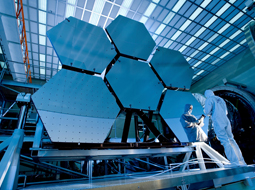
Department of Mathematics, Physics and Electrical Engineering
This department encompasses all of our work in Mathematics, Statistics and Physics including Astrophysics, Electrical and Electronic Engineering, Energy, Smart Materials, Microelectronics and Communications.
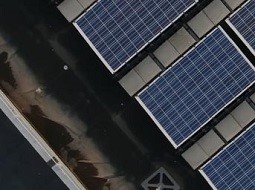
Our energy materials and systems research uses fundamental physics, chemistry and engineering to develop new ways to generate and store renewable energy - to help deliver a cleaner and greener future.
Our academics are delivering high impact research to understand big societal questions around how citizens can be empowered to digitally – and interactively - engage with governments, political organisations, healthcare providers and civic authorities on a local and national scale.
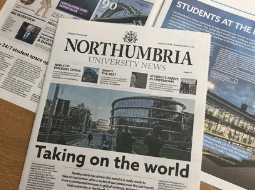
This is the place to find all the latest news releases, feature articles, expert comment, and video and audio clips from Northumbria University
Northumbria University News is packed full of news and features covering everything from research projects and business partnerships to student and staff awards.
Latest News and Features

New Student Health Hub brings joint health and wellbeing support
A new drop-in service is bringing health and wellbeing support for students at both Newcastle…

Researchers aim to grow optical fibres using biology instead of machinery
A new project led by Northumbria University aims to grow optical fibres using proteins, mimicking…

Training the next generation of space scientists
Northumbria University has hosted a major international workshop, bringing together leading…
.png?modified=20261006102851)
International design competition to grow the colour of the future
Researchers at Northumbria University and Imperial College London have launched an international…

Northumbria graduates celebrated at North East Business Awards
Graduate entrepreneurs from Northumbria University are celebrating after winning recognition…

How facial recognition failures harm people with facial differences
Researchers at Northumbria University's Centre for Responsible AI are working with Face Equality…

New Master Research Agreement strengthens commitment to cutting-edge research and innovation
Northumbria University and Lockheed Martin Space UK have signed a new Master Research Agreement,…

Speeding glaciers drive half a century of polar ice loss
The longest satellite record ever assembled shows that Greenland and Antarctica have lost 11.3…
More events
Upcoming events

Next Stop Northumbria
Europa Hotel
-
The Past We Inherit. The Future We Build: Better Decisions Happen Together
The Great Hall, Sutherland Building
-
Next Stop Northumbria
Manchester Marriott Hotel Piccadilly
-
