What is the Solicitors Qualifying Examination (SQE)?
Before September 2021 anyone wishing to qualify as a solicitor had to undertake the Legal Practice Course (LPC). The Solicitors Regulation Authority (SRA) introduced the Solicitors Qualifying Examination (SQE) route to qualification in September 2021. The SQE is a national assessment for anyone who wants to qualify as a solicitor in England and Wales. It provides a fair and consistent assessment for all candidates regardless of whether they have taken a law degree or qualified through new routes like the solicitor apprenticeship. The SQE will eventually replace the LPC entirely, but there is currently a period of transition and we are continuing to offer our LPC course as a route to qualification for the next few years.
Broadly, if you started your law degree or an exempting law degree or Common Professional Examination (CPE)/Graduate Diploma in Law (GDL), before the SQE was introduced, you should be able to still qualify under the LPC route (or you could choose to qualify under the new system).
Dr Victoria Roper, Associate Professor at Northumbria University, answers crucial questions about the new Solicitors Qualifying Examination in the BBC's podcast series; Not All Lawyers Have Law Degrees.
The Solicitors Qualifying Examination (SQE) is a new route to qualification as a solicitor from September 2021.
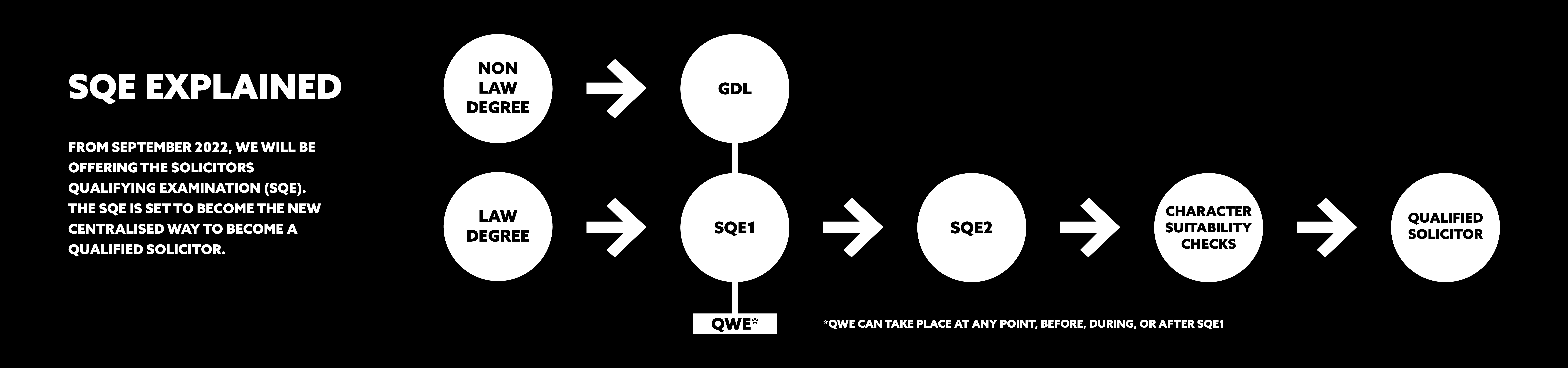
The introduction of SQE means that the assessments required to become a solicitor have been centralised with every aspiring solicitor sitting the same national assessment. Under the SQE route to qualification to become as a solicitor it is necessary to:
Have a degree or equivalent;
Pass the two stages of the SQE national assessment: SQE1 and SQE2;
Undertake a two-year period of work experience; and
Meet the character and suitability requirements to become a solicitor.
The SQE Assessment is split into 2 stages: SQE1 and SQE2:
SQE1 – A test of your ‘functioning legal knowledge’ and application of law based on realistic client scenarios. This stage consists of 2 multiple choice papers of 180 questions each. To progress onto SQE2, the student must pass SQE1.
SQE 2 – A test of your practical legal skills including interviewing (notes and analysis), advocacy, research, drafting, writing, and case analysis.
As mentioned above, ‘Qualifying Work Experience’ (QWE) is also required as part of the SQE route. The Solicitors Regulation Authority (SRA) anticipate that student’s gain this experience before sitting SQE2 although this is not a requirement. A minimum of two years full time equivalent is required and QWE is more flexible than the concept of a period of recognised training under the LPC route. Whilst many students may still choose to complete this requirement by undertaking one period of formal training with a law firm, work undertaken with up to 4 organisations can be used to satisfy the QWE requirement. A greater range of work experience can also count now than previously. This new development provides students with more flexibility and gives students an opportunity to widen their knowledge through a greater range of work experience increasing the potential pathways to qualification.
There is a cost of sitting the SQE assessments, in addition to any course tuition fees. The SRA regularly updates information and guidance about how to qualify under the SQE system so keep checking its website.
Under the LPC system you must complete both the academic and vocational stages of training as well as meeting the character and suitability requirements to become a solicitor.
The academic stage is achieved by either a) a Qualifying Law Degree or b) a non-law degree in a different subject and completing the CPE/GDL.
The vocational stage is completed by passing the LPC and undertaking two years of recognised training (known as a Training Contract). During the training contract, students will also undertake a final assessment as part of the Professional Skills Course (PSC). In summary, under the LPC route to qualification it is necessary to:
- Complete a QLD or a non-law degree followed by a CPE/GDL;
- Complete the LPC;
- Undertake a two-year period of recognised training (training contract); and
- Complete the Professional Skills Course (PSC).
Northumbria's provision is designed in consultation with employers to ensure that you are well-prepared for practice in a rapidly changing legal environment. We will continue to collaborate with our partners to ensure that we provide the high-quality training needed to prepare learners for the SQE assessments.
Although a training course is not prescribed by the Solicitors Regulation Authority the SQE is a demanding and high-stakes assessment and Northumbria’s state-of-the-art SQE courses are designed with you in mind to enable you both pass the SQE and to prepare you for practice as a solicitor.
The course will be full-time, on-campus over three semesters. In the first and second semester, you will study the 5 core areas covered on the SQE 1 assessment as follows:
- Business Law & Practice
- Dispute Resolution
- Property Law & Practice
- Wills & Administration of Estates
- Criminal Law & Practice
The remaining modules consist of a legal research module which will provide the skills and knowledge needed in order to complete a research dissertation. You will complete this over the course of the year, with the final write-up and hand-in in semester 3.
LLM in Professional Legal Practice
SEMESTER 1
- BLP (SQE 1) 20 Credits
- Dispute resolution (SQE 1) 20 Credits
- Legal research 20 Credits
SEMESTER 2
- PLP (SQE 1) 20 Credits
- Wills & Administration of Estates (SQE 1) 20 Credits
- Criminal law and practice (SQE 1) 20 Credits
SEMESTER 3
- Hand in of LLM dissertation (Year Long) 60 Credits
There will also be additional legal knowledge support/wrap around packages relating to core legal knowledge provided through online podcasts and tests underpinning the taught practical modules. These support packages will cover all the legal elements of the SQE allowing you to supplement the legal knowledge that you already have. These online learning materials will help with learning and online multiple choice tests to replicate and prepare for the SQE assessment. The series of online legal knowledge support packages will allow you to revise relevant legal areas, and to ensure that you have covered all areas by the SQE which may not have been addressed in your undergraduate law degree. This will provide flexibility in your learning and tailor your efforts to what you need to do to achieve in this area.
The teaching will be carried out by high-quality staff with a strong blend of teaching, professional practice and research expertise. There is also the opportunity for you to obtain experience with volunteering outside of legal support agencies, providing the opportunity to put into practice the knowledge and skills that you develop through the course. The programme will not only prepare you for the SQE 1 assessment but will also provide employment ready skills so you are ready for practice and set the framework for your SQE 2 assessment.
You will be supported throughout the course through face to face teaching, support packages, and by your personal tutor who will be able to offer advice and support throughout the demanding programme. Careers advice is provided by our dedicated careers support team and through the annual law and business fair which takes place in November.
SQE 1 Assessment
The SQE 1 assessment is a demanding assessment covering a multitude of different areas including testing complex legal knowledge over the key areas:
- Contract law
- Tort law
- Legal system of England and Wales
- Public Law
- EU Law
- Land law
- Trusts
- Criminal law
It also tests practice knowledge in:
- Business
- Dispute Resolution
- Property
- Wills
- Crime
In order to pass the SQE 1 you will need to have detailed and in-depth knowledge of these areas. The dissertation will allow you to study an area of interest in greater depth alongside an experienced academic tutor, as you work towards your LLM qualification.
SQE 2 Assessments
The SQE 2 will be assessed by 16 written and oral simulated tasks over five half days. The six practical legal skills are:
- Client Interviewing and Attendance Note / Legal Analysis;
- Advocacy;
- Case and Matter Analysis;
- Legal Research;
- Legal Writing;
- Legal Drafting.
They will be assessed within five contexts, each of which will be underpinned by Functioning Legal Knowledge. The five contexts are:
- Criminal Litigation;
- Dispute Resolution;
- Property Practice;
- Wills and Intestacy, Probate Administration and Practice; and
- Business Organisations, Rules and Procedures.
In order to pass the SQE 2, you will need to have the ability to demonstrate your practical legal skills within the relevant contexts.
We will be offering SQE 2 training from 2023 and continue to provide the training required by the current route to qualification, the Professional Skills Course.
To be notified for when our courses are available for applications. Please leave your details here.
For further information about any of our postgraduate law courses please email nu.postgraduate@northumbria.ac.uk
Students without a law degree but with a degree in another discipline are permitted to take the SQE assessments, however due to the level of legal knowledge required for the assessments students will need a thorough grounding in key legal principles to do well in the SQE. Our Graduate Diploma in Law (GDL) covers the foundations of law in depth whilst our LLM in Legal Professional Practice is specifically designed to build on this foundational knowledge and help you pass the SQE1 assessments. After the SQE 1 pilot, Kaplan (the assessment provider) and the SRA reported that initial indications were that educational factors (such as completing the GDL) were key predictors of success in the SQE1.
SQE Explained
Join us for a virtual open day here at Northumbria University
Meet our esteemed academics, chat with current students and take part in virtual talks on the subjects that you are interested in.