
Chris Ashford, Professor of Law and Society at Northumbria University, writes about the historical events that lead to a shift in attitudes towards gender and sexuality.
It was a summer evening in 1954 and the home secretary, David Maxwell Fyfe, was travelling on the Liverpool to London sleeper train. His accompanying security detail passed him a note from a man called John Wolfenden. Fyfe had been due to meet with Wolfenden the following week but Wolfenden – on seeing Fyfe on the passenger manifest – suggested that he might pop by his compartment and have the conversation now. A half-dressed Fyfe put on an overcoat and invited Wolfenden in.
The conversation that these two men would have – sat side-by side on the home secretary’s sleeping berth – would set in motion a series of events that would lead to Sexual Offences Act 1967 and the partial decriminalisation of homosexuality in England and Wales.
Wolfenden, who recounted this story in his 1976 memoir, discovered that night that he was being invited to chair a new committee to consider the law relating to both prostitution and homosexuality. Both areas brought together issues of morality, legality and debates about the role of the state in regulating sexual behaviour.
A review of the law relating to prostitution was prompted, Wolfenden subsequently wrote, by a growing visibility and persistence of soliciting (prostitution per se was not a criminal offence in itself but a number of 19th-century laws did serve to outlaw loitering or importuning) and a fear that the law was being brought into disrepute. Homosexual behaviour on the other hand was regarded as “unnatural vice” – a threat to individuals and society – but also a behaviour attracting a range of different police responses, including the use of agent provocateurs. There was also considerable scope to blackmail homosexual men.
The reason for Wolfenden’s selection to chair the committee remains unclear. Then vice chancellor of Reading University and a former Oxford don, he speculated that this academic independence perhaps enabled him to be a committee chair. But he was also careful to note in his memoirs that it “cannot have been because I was an expert in either of these two subjects [of prostitution and homosexuality]”.
Despite the historic public silence around homosexuality, it was increasingly breaking through into the public imagination. There were frequent arrests for public sex offences prior to the 1956 Sexual Offences Act drawing upon a combination of 19th-century laws and the common law. This legal landscape prompted a growing number of cases of men being threatened with extortion via fake or real accusations of homosexuality, along with the high-profile trial of journalist Peter Wildeblood and peer Lord Montagu in the 1950s.
In 1953, the actor John Gielgud would find himself in what he would later describe as “a disagreeable incident” in which he was arrested for cottaging in London. The story of Gielgud soliciting in a public lavatory for sex would be covered in the press but would not ultimately harm his career. He was cheered as he appeared in a new play in Liverpool and then later in London. This suggested the public – albeit the theatre-going one – appeared rather more supportive than the media.
Into this mix, dropped the Wolfenden Report in 1957, recommending that homosexual behaviour between consulting adult men in private should no longer be criminalised. The report also indicated that it expected gross indecency to continue to exist as an offence. The permanent secretary at the Home Office told Wolfenden: “don’t expect legislation quickly”. Ministers, upon being presented with the report, told Wolfenden that he was “way out in front of public opinion”.
The 1967 Act
The civil servant’s prediction proved pretty accurate. It took ten years for legislation to transform the Wolfenden recommendations into law. In the meantime, the 1961 film Victim, starring Dirk Bogarde and Sylvia Syms would depict – in a bold cinematic intervention – the very extortion of gay men that Wolfenden had been set up in part to tackle.
The reforming Labour home secretary, Roy Jenkins, would provide private encouragement in order to allow a backbench law to enact Wolfenden’s recommendations to gain parliamentary time and ultimately, support in the late 1960s. At the third reading, the Sexual Offences Bill 1967 was passed by 101 votes to 16, overcoming a decade of debate and resistance since the Wolfenden report.
With just 11 sections, the 1967 Act was a relatively short piece of legislation. Its long title indicated that it was “an Act to amend the law of England and Wales relating to homosexual acts”. The first section would indicate that “a homosexual act” in private would no longer be an offence, provided that the parties were 21 years of age or older. The second section contained two further caveats that would signify a broader attitude to homosexuality. First, it would be offence when more than two persons took part or are present, and it would be an offence if an act took place in “a lavatory to which the public have or are permitted to have access, whether on payment or otherwise”.
It is worth noting that the legislation was focused on male homosexuality. Traditionally, the law had been preoccupied with acts of buggery and sodomy and conceptualised these acts as solely male-based. While lesbianism was also considered an “unnatural vice”, sex between two women was never actually illegal in the UK.
The 1967 Act was not a sudden embracing of homosexuality by the law. It was, at best, tentative. The law had found itself intervening when gay men were being either the victims of blackmail or being visible. This law was designed to put male homosexuality out of sight and end it being an issue of public debate. The law on public lavatories regarding the ongoing acts of “cottaging”, or seeking sex in public toilets, may perhaps seem a historic curiosity today. Yet, the section was restated as recently as 2003 and remains in force. Taken together with the common law on outraging public decency, the law continues to operate today: no two men may have sex in a public lavatory.
In February 2017, two men were arrested in a Newcastle shopping centre toilet, found guiltyof sex in a public lavatory by local magistrates and fined £180 and £120 respectively. No reports indicated that any actual sex activity had been witnessed by the public or shopping centre workers but their public naming, shaming and, significantly for both men’s future’s, criminalising was evocative of an earlier age. It showed that this darker side of the 1967 Act continues to have a legacy today in determining what homosexual acts are acceptable under the law and which are not.
The Act described “homosexual acts” as being either buggery or “gross indecency”, a concept introduced into law in 1885 and restated in the Sexual Offences Act 1956. Gross indecency was designed to criminalise those men where buggery could not be proven and would be the offence that would lead to the criminal convictions of both Oscar Wilde and Alan Turing. The offence remained on the statute book until 2004 when the Sexual Offences Act 2003 came into force, repealing the 1956 Act offence. This was the same year that the Civil Partnership Act was passed.
Lord Arran, who had been the shepherd of the 1967 law in the House of Lords, famously stated when the Act was passed that gay men should now “show their thanks by comporting themselves quietly and with dignity”. The quote is sometimes now seen as suggesting his words reflected a broad conservative sentiment. This is true, but Lord Arran, in a collectionof his journalistic writing published in 1964, would offer jokes about infidelity and sex, noting that: “Sex is the greatest possible fun. But not something to be taken too seriously.”
Homosexuality was not just sex, it was in a different category and although it had been decriminalised, it was still very much something to be taken seriously.
The rights era
The 1967 Act only decriminalised homosexuality in England and Wales. It would take until the passing of the Criminal justice (Scotland) Act in 1980 for Scotland to come in line, and it would take the Dudgeon v United Kingdom case before the European Court of Human Rights in Strasbourg in 1981 for the law to be changed in Northern Ireland in 1982. That case – which found that the continued criminalisation of homosexuality in Northern Ireland breached Article 8 of the European Convention on Human Rights – would later be cited in the 2003 US Supreme Court decision of Lawrence v Texas, a case that struck down the sodomy laws of 14 states.
The first decade following the passing of the Sexual Offences Act was uneventful. It would be a conflict between the Thatcher government of the 1980s and a growing radicalism on gender and sexuality from Labour-controlled councils in the great cities that would lead to the next major spark in statutory reform.
Section 28 of the Local Government Act 1988 set out to ban material or teaching that would “promote” homosexuality. The law, which we might today better associate with Putin’s Russia, was repealed in 2003. You would have to be currently aged 14 or under to have not been affected by this legislation. It contained two key provisions, stating: a local authority shall not (a) intentionally promote homosexuality or publish material with the intention of promoting homosexuality; and (b) promote the teaching in any maintained school of the acceptability of homosexuality as a pretended family relationship.
The law simultaneously sent out the government-mandated signal that homosexuality was not something to be “promoted” and that it could not constitute a “real” family, only a “pretend” one.
While the law was never used as part of a prosecution, it had a chilling effect on the freedom of expression relating to homosexuality. The National Council for Civil Liberties, the forerunner to Liberty, sought to catalogue this impact in its 1989 guide to the law. They noted plays cancelled and LGBT student groups banned from college premises as a result of the law.
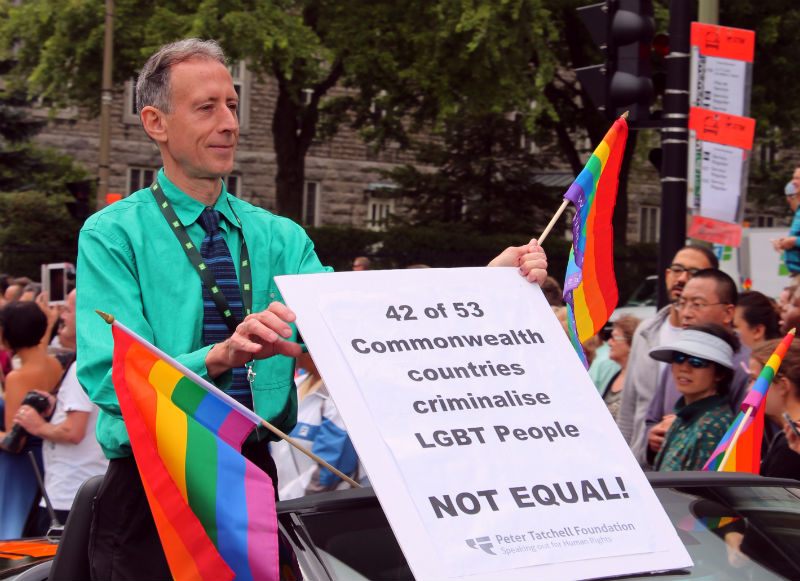
Peter Tatchell / Shutterstock
The legislation was also significant for sparking the formation of the cross-party LGB (and later LGBT) campaign organisation, Stonewall. The organisation brought together Labour’s Michael Cashman with the Conservative Matthew Parris along with celebrities including the actor Ian McKellen. It would be this organisation that would be in the campaigning vanguard in the years that followed, often being a lead organisation for consultations between government and the LGBT “community”.
The Human Rights Act 1998, made law ten years on from the Local Government Act, was another turning point, signalling the start of a rights-based approach that would ultimately lead to the Marriage (Same Sex Couples) Act 2013. In the years following 1998, significant legal reform followed. The age of consent for same-sex would finally be lowered from 18 to 16-years-old in 2000, new employment protections would be passed in 2003, and goods and services protections would come in 2006. Civil partnerships were made law in 2004, the same year as the Gender Recognition Act, followed by the Human Fertilisation and Embryology Act in 2008 and subsequent laws to address historic wrongs.
Militant dreams
For some, the same-sex marriage law signalled the end of a journey that had begun in 1967. The then head of gay rights campaign organisation, Stonewall, Ben Summerskill, described the law as the final piece of the legislative jigsaw.
Yet who decided that this was the final picture, the end-point of gay rights? There was no vote, or consultation on what gay rights should look like. In the march from 1967 to the present day, few stopped to ask “where are we going?”. In a sense, it speaks to the transformed legal landscape that there are now growing numbers of voices asking this question.
Shifting attitudes towards gender and sexuality, notably in the increased embracing of gender-fluid and queer identities is creating a social and political driver for re-evaluating our laws. During the passing of same-sex marriage the then MP, Gerald Howarth referred in Parliament to “aggressive” homosexuals, later amending it to “militant”, fearing that the Act would lead to further radical reforms. He would subsequently justify his remarks based on the activism of Peter Tatchell, and my own writing.
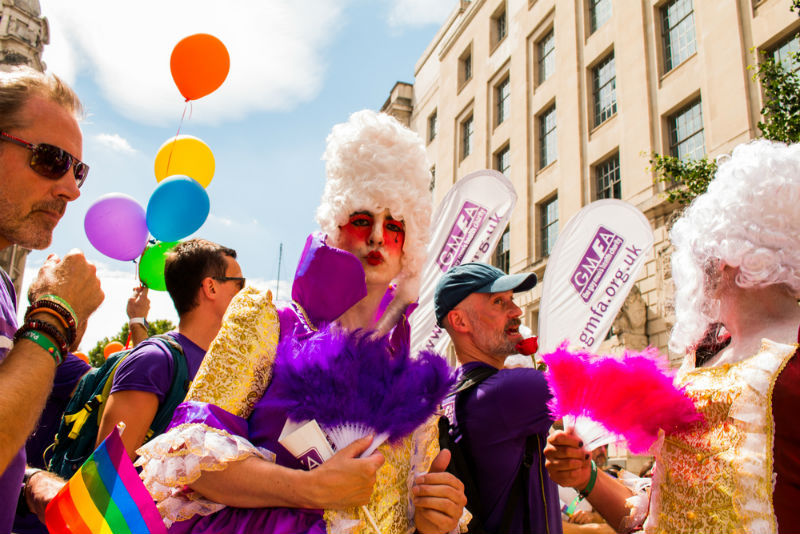
Celebrating pride / Shutterstock
This radical or militant agenda is activists and academics asking the questions that will shape our next steps following 1967. This shift to greater emphasis on the fluidity of gender and sexuality enables us to now shift the conversation surrounding how we seek to regulate both sex and gender rather than to continue to previous narrative of “LGBT rights”. In doing so, it also shifts the attitude from something to be bestowed from the state via positive rights to a radical assertion of freedom; of liberation.
The Sexual Offences Act 1967 remains a major watershed in the legal status of homosexuals in the UK, which is why its 50th anniversary has been celebrated so widely in 2017. But it also signalled the start of a journey that has not, and arguably never will, end. A half-dressed home secretary and an academic would change the world from a shared bed. I need to take more rail journeys.
This article was originally written for The Conversation. Read the original article here.
Latest News and Features

Recognition for researcher dedicated to tackling food insecurity in the UK
A Northumbria University academic who has played a key role in bringing breakfast clubs and…

University partnership brings space research to life for school pupils
A North East school has partnered with solar and space physics experts from Northumbria University…
.png?modified=20250916102106)
Telescope reveals surprising secrets in Jupiter's northern lights
An international team of scientists, led by a PhD researcher from Northumbria University, has…

Northumbria Film graduates receive Royal Television Society honours
Two Northumbria University Film graduates have won Royal Television Society (RTS) Student Awards…

Scientists reveal the best and worst-case scenarios for a warming Antarctica
A new analysis of decades of research on the Antarctic Peninsula, involving experts from Northumbria…

PhD student maps mysterious upper atmosphere of Uranus for the first time
A Northumbria University PhD student has led an international team of astronomers in creating…

Developing technology to help empower young innovators across the globe
Northumbria University researchers have joined forces with the International Federation of…

Working-class roots drive North East graduate’s AI healthcare revolution
A Northumbria University graduate has developed groundbreaking AI technology that could save…
More events
Upcoming events
Launch of the Northern Interprofessional Education Strategy
Northumbria University
-
