
Claire Nally, Senior Lecturer in Twentieth-Century English Literature at Northumbria, writes about subculture for The Conversation.
In a global environment in which blandness seems to rule and people are more connected – and therefore arguably more homogenised – than ever, subcultures might seem to be on the decline. But this is far from the case. Subcultures encompass a broader range of people than just today’s youth, as Paul Hodkinson’s research on goth and ageing has shown.
Twice a year each year, a curious event occurs in a small seaside town: Whitby Goth Weekend. Originally organised as a goth gathering in 1994, the festival is now one of the larger events in the European goth calendar. The festival, the most recent of which occurred over the first weekend of November, no longer attracts only goths – many steampunk enthusiasts, among others, have started to attend, too. So what does this say about subculture today?
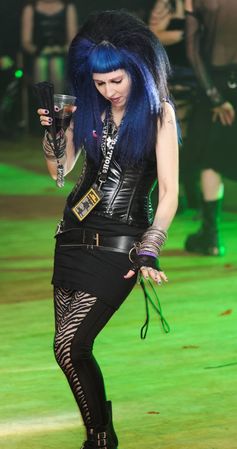
Goth is characterised most famously by the notion of a dark aesthetic, so that sartorial choice is often influenced by a melancholic sensibility (black clothes, piercings, tattoos). This is not to say the culture is miserable, as Catherine Spooner’s forthcoming book carefully notes. Indeed, Whitby Goth Weekend’s wryly humorous side is obvious if we look at the festival’s annual football event, featuring black clad footie supporters, and players with improbably long, dark hair.
Dracula’s backyard
While the foundations of Whitby Goth Weekend relate to a very specific subcultural and musical affiliation, in recent years this has somewhat diversified. Whitby now attracts many attendees who might not identify as goths. They celebrate the spectacle of fashion and the photographic opportunities. Many of these people are drawn to the literary legacy of the Abbey and St Mary’s Church, which featured in Bram Stoker’s 1897 novel, Dracula. This has prompted much chagrin from some attendees, who see it as a detraction from the subculture itself.
There are, of course, long standing debates in theories of subculture about the nature of authenticity and boundary marking, including Sara Thornton’s idea of “subcultural capital” (1995), which she maintains is linked to an assertion of distinctiveness, and a claim to subcultural authority. Ross Haenfler notes that while individuality, tolerance and creative free play are often vaunted as markers of subculture, in practice, there are always “battles over hierarchy”.
But the festival, as much as the subculture, does not stand still: recent appearances by synth-rock outfit William Control, and the London-based dark wave band, Cold in Berlin, testify to a new type of sound, and a different generation of attendees.
Such diversification also includes other genres, such as steampunk. In 2007, James Richardson-Brown (Captain Sydeian) organised the first steampunk meet-up in Whitby, to coincide with the festival. Since that time, steampunks have congregated alongside the traditional community in a series of fringe events hosted at The Rifle Club. This is not to say that there isn’t an overlap in these subcultures: one of the most preeminent steampunk bands, Abney Park, have headlined at the main event three times. Such a shift indicates a fluidity within both subcultures.

‘I love a girl in goggles’
The author KW Jeter is usually credited with coining the word “steampunk”, which he later identified as “a taste for brass and copper and the ticking, hissing mesh-&-grind of Victorian technology”. He characterises steampunk as an aesthetic resistance to the smooth surfaces of contemporary mass production. Many steampunk participants also embrace this aspect of retro-technology in their attire.
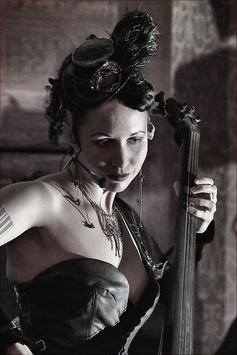
Notably, unlike goth, steampunk originated from literary rather than music culture: it embraces anachronism and science fiction, with reference points including figures such as H G Wells, Mary Shelley, and Jules Verne. Steampunk at its best is avowedly political:
A performer such as Unwoman, whose stage name is tellingly derived from Margaret Atwood’s dystopian novel, The Handmaid’s Tale (1985), engages with many of these themes in her 2012 album The Fires I Started. At the same time, The Men That Will Not Be Blamed For Nothing emphasise the “-punk” aspect of the genre, castigating the inequalities of the Victorian age in songs like Third Class Coffin.The Steampunk Magazine represents a repository of radical politics, including debates around gender, activism and anti-capitalism.
Steampunk is synonymous with sepia tones, alongside a nostalgic but not uncritical approach to the Victorian period. It encompasses technology, and arts and crafts practice, but there is a much darker side, too, which Captain Sydeian and others have characterised as Steamgoth.
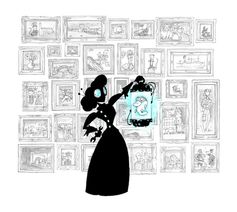
So where are UK subcultures headed from here? The idea of synthesis between subcultures does not necessarily spell their end – indeed, ideas of what Hodkinson calls a “pick-and-mix” approach characterise contemporary debate around these identities. For Whitby attendees, it’s possible any resentments might be tempered in future. The steampunk community has secured its own weekend in Whitby (February 2017), as well as having several other events dedicated to their particular strand of subculture (The Lincoln Asylum being the most obvious of these). Even in the era of globalisation, it seems the idea of a localised belonging is very important.
This article was orignially published in The Conversation. Read the original article here.
Latest News and Features

Speeding glaciers drive half a century of polar ice loss
The longest satellite record ever assembled shows that Greenland and Antarctica have lost 11.3…

Northumbria physicist elected Fellow of the Institute of Physics
Dr Juna Sathian, an Associate Professor at Northumbria University, has been elected a Fellow…

Northumbria helps shape national plan to boost graduate employability
Northumbria University has played a key role in shaping a new national plan designed to help…

Northumbria researcher joins appeal to Downing Street on free school meals and holiday support
A Northumbria University academic, whose research has played a key role in bringing breakfast…

Ancient wildfires near the South Pole shaped Earth's earliest peat bog
Wildfires raging through prehistoric rainforests helped create the earliest known peat bog…

Northumbria astronomer helps reveal secrets of rare interstellar visitor
A Northumbria University astronomer has helped uncover new clues about a rare icy object from…

Two Northumbria professors elected Fellows of the Academy of Social Sciences
Two leading academics from Northumbria University have been elected to the Fellowship of the…

New scientific review involving Northumbria researchers identifies Antarctic coastal blind spots limiting sea level projections
A new international, community-led, scientific review warns that major gaps in knowledge along…
More events
Upcoming events


IPE Conference 2026
Northumbria University
-

Specialist Teaching Assistant Degree Apprenticeship - In-person Information Session
Coach Lane Campus
-

Next Stop Northumbria
Europa Hotel
-
