
Beekeepers in the North East are being invited to take part in a Northumbria University research project exploring the difference between the plants favoured by city and country bees.
The ‘City Slickers versus Country Yokels’ project will look at the differences in the foraging behaviours between urban and rural bees.
The team behind the project are now looking to recruit beekeepers in Newcastle and the Tyne Valley to take part in the research, which is being supported by the British Beekeepers Association.
Those taking part will be asked to collect pollen pellets from their hives once a fortnight and provide small samples of honey. These will then be analysed by the team at Northumbria to determine what flowers and plants the bees have been feeding on. A comparison between the habits of the city bees and their rural counterparts will then be made.
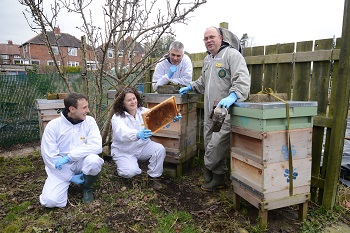 Matthew Pound, a Senior
Lecturer in Geography at Northumbria and pollen analysis expert, said: “By
analysing pollen pellets and honey in our lab we can establish where the bees
have been foraging. Over the season, this will provide us with a good insight
in where bees in rural areas and bees in the city find their food.
Matthew Pound, a Senior
Lecturer in Geography at Northumbria and pollen analysis expert, said: “By
analysing pollen pellets and honey in our lab we can establish where the bees
have been foraging. Over the season, this will provide us with a good insight
in where bees in rural areas and bees in the city find their food.
“We know that bees visit flowers to collect nectar and pollen, but which flowers? Do rural bees mainly fly on crops, or do they use a collection of wild flowers? And with urban beekeeping now becoming increasingly popular we hope to find out more about where these city bees go.”
The results of the research will help scientists understand more about the risks of accumulating agricultural pesticides in honey, as well as how to provide better habitats for bees in the region in the future.
Working alongside Matthew is Rinke Vinkenoog, a Senior Lecturer in Biology at Northumbria. He added: “Traditionally, we associate the countryside with wild flowers and buzzing bees – rich in biodiversity and a haven for beekeepers. However, modern agriculture and biodiversity do not always go together well.
“We now see pollination in rural areas under threat, whereas urban areas offer surprising opportunities for flower-visiting insects – not just honeybees, but many other pollinators as well. In addition to studying honeybees, we also aim to monitor the diversity in pollinators in both areas.”
Urban beekeeper Ian Campbell has 15 hives located in central Newcastle, which house up to 750,000 bees summer. He is taking part in the project and said: “The forage bees find is vital to their wellbeing. As a beekeeper it’s great to be involved in a project that can provide evidence to help us better understand their food sources in different locations. The information will assist us to keep strong healthy colonies.
Student volunteers from Northumbria are being recruited to support the project by visiting the beekeepers involved, collecting honey and pollen samples, analysing them in the lab and carrying out ecological surveys of flower-visiting insects.
Dr Helen Hooper is Head of the Biology, Food and Nutritional Sciences Department in the School of Life Sciences at Northumbria and will be working with both the student and beekeeper volunteers involved.
She said: “Taking part in a funded research project is a great opportunity for our students. They will learn new skills and gain hands on experience of science in action, taking part in experimental design, data collection, data analysis and presentation.
“It will also be a fascinating experience for the beekeepers taking part – they will gain a much deeper insight into the activity of their bees and learn more about the particular feeding characteristics of rural and urban bees.”
The project has received funding of £7,100 from the British Beekeepers Association.
British Beekeepers Association President Margaret Murdin said: “The British Beekeepers’ Association is delighted to be supporting this important work at the University of Northumbria. The nutrition of our honeybees is of vital importance and we will be interested to see if there are dietary differences between honeybees in urban areas and those in the countryside.”
To find out more about taking part in the project, please contact:
Helen Hooper: h.hooper@northumbria.ac.uk or 0191 227 3181 / 07432 547 281
Matthew Pound: matthew.pound@northumbria.ac.uk or 0191 227 4410
Rinke Vinkenoog: rinke.vinkenoog@northumbria.ac.uk or 0191 227 3508
Latest News and Features

Speeding glaciers drive half a century of polar ice loss
The longest satellite record ever assembled shows that Greenland and Antarctica have lost 11.3…

Northumbria physicist elected Fellow of the Institute of Physics
Dr Juna Sathian, an Associate Professor at Northumbria University, has been elected a Fellow…

Northumbria helps shape national plan to boost graduate employability
Northumbria University has played a key role in shaping a new national plan designed to help…

Northumbria researcher joins appeal to Downing Street on free school meals and holiday support
A Northumbria University academic, whose research has played a key role in bringing breakfast…

Ancient wildfires near the South Pole shaped Earth's earliest peat bog
Wildfires raging through prehistoric rainforests helped create the earliest known peat bog…

Northumbria astronomer helps reveal secrets of rare interstellar visitor
A Northumbria University astronomer has helped uncover new clues about a rare icy object from…

Two Northumbria professors elected Fellows of the Academy of Social Sciences
Two leading academics from Northumbria University have been elected to the Fellowship of the…

New scientific review involving Northumbria researchers identifies Antarctic coastal blind spots limiting sea level projections
A new international, community-led, scientific review warns that major gaps in knowledge along…
More events
Upcoming events


IPE Conference 2026
Northumbria University
-

Specialist Teaching Assistant Degree Apprenticeship - In-person Information Session
Coach Lane Campus
-

Next Stop Northumbria
Europa Hotel
-
