
Scientists from Northumbria University, Newcastle are developing a wearable diagnostic device or ‘patch’ that could speed up the diagnosis of illnesses, potentially saving many lives.
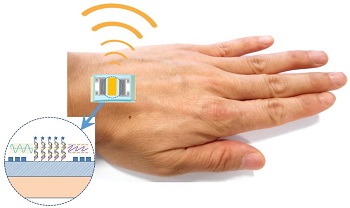 Members of Northumbria’s
Smart Materials and Soft Matter research group are creating a new, non-invasive,
mechanically flexible, thin film material using polymers or metallic foils,
after receiving £433,000 worth of funding to develop the new technology.
Members of Northumbria’s
Smart Materials and Soft Matter research group are creating a new, non-invasive,
mechanically flexible, thin film material using polymers or metallic foils,
after receiving £433,000 worth of funding to develop the new technology.
The material would be used to create a device featuring biosensors which could be applied directly to someone’s skin to detect, record and transmit physiological information. It would analyse different body fluids to give a quick and accurate diagnosis of a person’s health. The material also contains microfluidics, which can control the movement of liquids such as samples of sweat.
The technology being developed by the Northumbria team is known as ‘lab-on-a-chip’ and allows tiny amounts of liquid to be screened and analysed by being moved around a small circuit, or ‘chip’ using a small electrical voltage.
The technology is usually only installed on hard, rigid materials, and the Northumbria team have pioneered a method to incorporate it onto a thin, flexible material, meaning it could be applied directly onto the skin, in the form of a patch or bandage.
The patch will work via a wireless electrical signal, delivered remotely by a health professional or the wearer. This signal will create a mechanical wave, that will interact with a liquid that it comes into contact with, moving it in different patterns depending on the strength of the voltage.
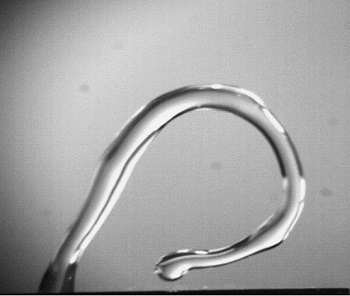
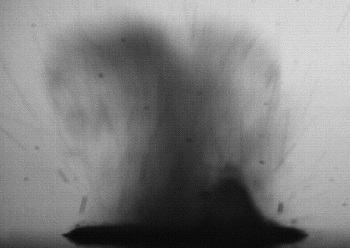
This allows the liquid to be separated depending on its properties – for example, different blood cells or pathogens could be split up by changing the electrical frequency. It can also eject the liquid or atomize the droplets, which could be further explored for bio-printing or drug inhaler devices (see images below).
 Results from the patch
screening would be delivered within minutes to an electronic device such as a
mobile phone. They could be analysed by the wearer for more simple tests such
as sweat ionic composition to establish hydration, similar to the commercial blood
sugar levels for someone with diabetes, or by a medical professional for more
in-depth analysis.
Results from the patch
screening would be delivered within minutes to an electronic device such as a
mobile phone. They could be analysed by the wearer for more simple tests such
as sweat ionic composition to establish hydration, similar to the commercial blood
sugar levels for someone with diabetes, or by a medical professional for more
in-depth analysis.
Although the research is still in the early stages, the technology could have a wide range of applications, including cleaning or filtering blood samples, analysing the effectiveness of drugs at treating diseases to personalise therapies.
The research has been published in high impact journals including Progress in Materials Science and Nature Communications.
The researchers’ work is being supported by the Engineering and Physical Sciences Research Council (EPSRC), which has provided Northumbria with more than £433,000 to develop the technology, together with partners at the University of Glasgow, who were awarded £350,000.
The research is being led by Professor Richard Fu, who has established a global reputation for his work around smart materials. Professor Fu is an expert in shape memory and piezoelectric thin films and nano-materials. Using shape memory thin films, he has developed a smart microgripper which can be used for manipulating cells or within microsurgery (see image below).
 Professor Fu said: “Our aim
is to create a bio-sensing device which could be applied directly to the skin
and analyse different body fluids to give a quick and accurate diagnosis of a
person’s health.
Professor Fu said: “Our aim
is to create a bio-sensing device which could be applied directly to the skin
and analyse different body fluids to give a quick and accurate diagnosis of a
person’s health.
“Acoustic wave-based lab-on-a-chip technology is already widely used but applying it to a thin, flexible material is a new concept and one which could revolutionise how diseases are diagnosed in future.
“Based on the expertise of our Smart Materials and Surface research group and our links with industry we hope to work with medical organisations to see how this type of technology could be used to deliver potentially life-saving benefits to people across the world.”
Further funding for the research has also been provided through a Royal Society-China Exchange Grant, and the special interest group, Acoustofluidics, under the UK Fluidic Network.
Find out more about Northumbria’s department of Mathematics, Physics and ElectricalEngineering and Smart Materials and Soft Matter researchgroup.
Latest News and Features

Speeding glaciers drive half a century of polar ice loss
The longest satellite record ever assembled shows that Greenland and Antarctica have lost 11.3…

Northumbria physicist elected Fellow of the Institute of Physics
Dr Juna Sathian, an Associate Professor at Northumbria University, has been elected a Fellow…

Northumbria helps shape national plan to boost graduate employability
Northumbria University has played a key role in shaping a new national plan designed to help…

Northumbria researcher joins appeal to Downing Street on free school meals and holiday support
A Northumbria University academic, whose research has played a key role in bringing breakfast…

Ancient wildfires near the South Pole shaped Earth's earliest peat bog
Wildfires raging through prehistoric rainforests helped create the earliest known peat bog…

Northumbria astronomer helps reveal secrets of rare interstellar visitor
A Northumbria University astronomer has helped uncover new clues about a rare icy object from…

Two Northumbria professors elected Fellows of the Academy of Social Sciences
Two leading academics from Northumbria University have been elected to the Fellowship of the…

New scientific review involving Northumbria researchers identifies Antarctic coastal blind spots limiting sea level projections
A new international, community-led, scientific review warns that major gaps in knowledge along…
More events
Upcoming events


IPE Conference 2026
Northumbria University
-

Specialist Teaching Assistant Degree Apprenticeship - In-person Information Session
Coach Lane Campus
-

Next Stop Northumbria
Europa Hotel
-
