
A Northumbria University academic has won a major international award in recognition of his exceptional scientific contribution to the field of glaciology.
The International Glaciology Society has awarded the Seligman Crystal to Professor Adrian Jenkins of Northumbria’s Department of Geography and Environmental Sciences.
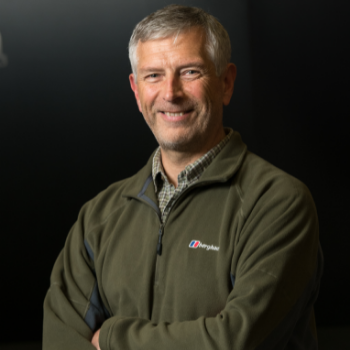
The crystal is awarded only to those who have undertaken research that has a long-lasting impact on the understanding, direction or focus of a glaciological discipline, or who have transformed the discipline in a unique way including opening a new area or radically transforming thinking.
Professor Adrian Jenkins has had an extensive career at the forefront of research into ice-ocean interactions for more than 35 years. Having formerly worked with the British Antarctic Survey, he moved to Northumbria University in 2020 to join the University’s world-leading Cold and Palaeo Environments research group.
One of his most important contributions was leading the team that discovered an unknown world beneath West Antarctica’s Pine Island Glacier in 2009.
The glacier flows into a floating ice shelf which was known to be thinning. This was allowing the glacier to contribute more to global sea level than any other in the continent.
Scientists had previously believed the seabed beneath the ice shelf to be flat, but thanks to Professor Jenkins’ research, it was discovered that this was not the case.
Professor Jenkins was keen to use new submarine technologies to observe the ocean beneath the ice shelves. After a number of thwarted attempts over a 10-year period the team successfully sent an Autosub beneath the ice shelf to map detailed features of the ice shelf base and seabed.
Autosub discovered that the seabed was not flat and was, in fact, very different, rising to a 300-m high ridge that bore the marks of earlier glacier flow, telling a different tale of how the glacier had changed over time. This mission completely changed scientific understanding of the thinning and retreat of Pine Island Glacier.
Thanks to this and subsequent studies, scientists were able to establish that the Glacier had actually begun to retreat in the 1940s, but as there was no satellite coverage of the continent at the time, it had gone unnoticed.
Scientists now have a far better understanding of how climate change is driving ice sheet retreat in the region and are continuing to build on this research.
Ian Allison, Chair of the International Glaciological Society’s awards committee said that Professor Jenkins has contributed “outstanding interdisciplinary work at the boundary of glaciology and oceanography” adding that his research in formulating and applying a plume model has been “fundamental to quantifying melting and freezing patterns under ice-shelves and in analysing marine ice deposition.”
The awards committee particularly praised Professor Jenkins’ work on subglacial outflow and his formulation of how ocean temperature, salinity and turbulent mixing combine to control the rate of ice melting in the ocean. They also commended his pioneering work in autonomous underwater vehicle deployment and the of development phase-sensitive radio echo-sounding for ice shelf observations.
Speaking about his award, Professor Jenkins said: “It really is a huge honour. I’ve been a member of the International Glaciological Society since working on my master’s thesis in 1985. Since then, while I’ve been gradually ‘growing up’ as a scientist, I’ve looked up to the previous recipients of the Seligman Crystal with a sense of awe and admiration. They really are a select bunch, including the very founders of the subject as we now know it.
“It is a surreal feeling to be joining them, and I’m still not really sure it has sunk in. I should really acknowledge the huge debt I owe to my mentors and collaborators over the years who have contributed so much in so many ways to various aspects of the body of work that is being recognised by the award. Science is a team effort and I’ve been lucky enough to work with great friends and colleagues throughout my career.”
Northumbria’s Cold and Paleao Environments research group is now believed to be the largest team of cold climate researchers in the UK. They are involved in major international studies including playing leading roles in the £20 million UK/US International Thwaites Glacier Collaboration and a £4 million EU-funded study assessing tipping points in the Antarctic climate system.
Hilmar Gudmundsson, Professor of Glaciology and Extreme Environments at Northumbria University said: “Northumbria University is fast becoming recognised as one of the world’s leading institutions in ice modelling and understanding the role of ice sheets in a global context.
“We were delighted to welcome Adrian to our team last year. His work has been the foundation for much of our understanding around global climate change, ice-ocean interaction and sea level change and I am so pleased that he has received such recognition for his outstanding efforts in climate research.”
In the run-up to the COP26 Climate Change Conference, Northumbria University is shining a spotlight on the work of its researchers in the field of climate change. Click here to read an interview with Professor Jenkins, highlighting his extensive research career, including some of the challenges he has faced on his many missions to Antarctica.
Images taken by Johan Rolandsson.
This is the place to find all the latest news releases, feature articles, expert comment, and video and audio clips from Northumbria University
Geography At Northumbria University Encompasses All Of Our Work In Physical And Human Geography, Environmental Science And Management, Health & Safety, And Disaster Management.
Latest News and Features
.png?modified=20261006102851)
International design competition to grow the colour of the future
Researchers at Northumbria University and Imperial College London have launched an international…

Northumbria graduates celebrated at North East Business Awards
Graduate entrepreneurs from Northumbria University are celebrating after winning recognition…

How facial recognition failures harm people with facial differences
Researchers at Northumbria University's Centre for Responsible AI are working with Face Equality…

New Master Research Agreement strengthens commitment to cutting-edge research and innovation
Northumbria University and Lockheed Martin Space UK have signed a new Master Research Agreement,…

Speeding glaciers drive half a century of polar ice loss
The longest satellite record ever assembled shows that Greenland and Antarctica have lost 11.3…

Northumbria physicist elected Fellow of the Institute of Physics
Dr Juna Sathian, an Associate Professor at Northumbria University, has been elected a Fellow…

Northumbria helps shape national plan to boost graduate employability
Northumbria University has played a key role in shaping a new national plan designed to help…

Northumbria researcher joins appeal to Downing Street on free school meals and holiday support
A Northumbria University academic, whose research has played a key role in bringing breakfast…
More events
Upcoming events

Specialist Teaching Assistant Degree Apprenticeship - In-person Information Session
Coach Lane Campus
-

Next Stop Northumbria
Europa Hotel
-
The Past We Inherit. The Future We Build: Better Decisions Happen Together
The Great Hall, Sutherland Building
-
Next Stop Northumbria
Manchester Marriott Hotel Piccadilly
-
