
The governing body of UK Research and Innovation (UKRI) has visited Northumbria University to find out more about research that is reshaping the UK’s space sector, tackling climate change and driving community innovation across the country.
UKRI invests £8 billion of government funding into science, research and innovation across the UK each year through seven disciplinary research councils – AHRC, BBSRC, ESRC, EPSRC, MRC, NERC and STFC – as well as Research England and the innovation agency, Innovate UK.
The visit was part of a wider tour of the North East’s five universities, organised by Universities for North East England (UNEE), to showcase how public investment in research is translating into real-world impact, regional progress and national innovation. UNEE is a collaboration between Durham, Newcastle, Northumbria, Sunderland and Teesside Universities.

Board members visited several university campuses to hear from a cross-section of those active in the region’s research and innovation activity, before gathering for a reception with researchers, innovators, university staff and governors and business leaders at Northumbria University and holding their board meeting at Sunderland University.
Whilst at Northumbria, members of the UKRI Board met with researchers specialising in space and solar physics and satellite communications engineering to learn more about their work.
Professor Clare Watt outlined her Science and Technology Facilities Council (STFC) - funded £4.3 million research which is examining how space weather affects critical national infrastructure – including power grids and satellites. Professor James McLaughlin presented Northumbria’s connections to the National Data Centre, underpinned by a further £1.3 million STFC grant, while Professor Eamon Scullion showcased the ALIGN programme which is developing autonomous laser communications between satellites.
Board members were then given a hard-hat tour of the University’s new £50 million North East Space Skills and Technology Centre, known as NESST. The centre brings together universities and industry partners, including the UK Space Agency and Lockheed Martin UK Space, to tackle some of the most pressing challenges in the global space sector, from optical communications between satellites to space weather monitoring and space-based energy.
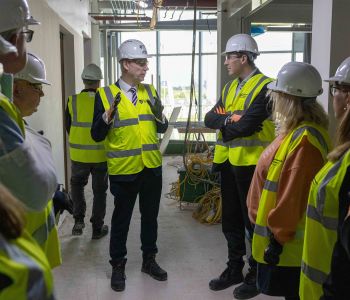
NESST is due to open later this year and is projected to create more than 350 jobs and contribute over £260 million to the North East economy over the next 30 years.
The Board also learned more about the University’s polar science work which is funded through the NERC Centre for Polar Observation and Modelling from Professor Andrew Shepherd and Dr Sammie Buzzard, and from Professor Neil Beattie who spoke about Northumbria’s role in the EPSRC Centre for Doctoral Training in Renewable Energy Northeast Universities.
World-leading research in the creative and cultural industries was also at the heart of the visit.
Professor Katy Shaw presented the Creative Communities programme which is supporting community-led cultural innovation across the UK with Claire Malcolm, Founder and Chief Executive of New Writing North, one of its key delivery partners. Creative Communities is a £3.85 million AHRC/UKRI-funded initiative.
Dr Alana James’s shared details on research into sustainable fashion through her IMPACT+ project, backed by £1.5 million from NERC, is developing environmental indices to drive transparency and circular economy practices across global supply chains.
The afternoon closed with a networking session where UKRI Board members spoke with Northumbria’s postgraduate researchers, viewing posters on UKRI-funded projects spanning art, design, literature and the digital humanities.
Other highlights of the UKRI visit to the region included an overview of a new drug developed at Sunderland University to improve the treatment of patients with the rare, life-threatening genetic disease, cystinosis, and a session outlining work at Newcastle University on the experience of patients with Lewy Body Dementia and how the North East is leading the way in research, developing treatments and improving care for people with the condition.
Teesside University showcased how place‑based research in the Tees Valley and the North East is delivering scalable solutions to health inequalities, clean energy transitions and regional productivity; both here at home and internationally, while Durham University shared its work in a number of areas including materials science and biological chemistry, and the role of digital humanities in heritage and museums.
Northumbria University’s Vice-Chancellor and Chief Executive, Professor Andy Long, who is also Chair of Universities for North East England (UNEE), said: “It was a privilege to welcome the UKRI Board to the region’s universities and share with them the impact of research and innovation activity happening in our region.
“The North East of England has always punched above its weight in terms of its contribution to UK research and innovation. Our collaborative approach allows us to utilise the diverse skill set of each institution, while also developing stand-alone projects in our individual areas of expertise.
“Our work supports considerable benefits to the country and region – economically, socially and culturally.”
UKRI’s Chief Executive, Professor Sir Ian Chapman, said that the Board was grateful to the university partners for hosting such a valuable and engaging visit.
“We’ve heard some fascinating examples of how research and innovation in the region is making a real difference – from advancing healthcare to driving clean growth and strengthening the UK’s technological capabilities,” he said.
“Visits like this play an important role in UKRI delivering its mission to advance knowledge, improve lives and drive growth for the whole nation. It is vital that we engage with and learn from communities right across the UK, recognising the strength of local collaboration and ensuring that the benefits of research and innovation are felt in every region.”
Click here to find out more about all aspects of Northumbria's research, from ice on earth to microbiome exploration.
Image caption:
Top: (L-R) Sir David Bell (Sunderland); Stephanie Bailes (Teesside); Professor Andy Long (Northumbria); Sir Ian Chapman (UKRI); Professor Sarah Hainsworth (Durham) and Professor Chris Day (Newcastle)

Northumbria’s Solar and Space researchers work to understand the physics of the Sun and all aspects of the solar-terrestrial connection to improve space weather forecasting.

Our energy materials and systems research uses fundamental physics, chemistry and engineering to develop new ways to generate and store renewable energy - to help deliver a cleaner and greener future.

Northumbria's academics are studying the future of ice sheets and glaciers worldwide in a warming world. This involves understanding the causes of ongoing changes in Antarctica, Greenland and alpine areas, as well as assessing future changes and resulting impacts on human environments globally.

The Cultural and Creative Industries are among the fastest growing and most innovative sectors in the UK. Our research in this area focuses on the opportunities and challenges this creates for education and skills, health and wellbeing, the environment, civic identity and pride in place.
This is the place to find all the latest news releases, feature articles, expert comment, and video and audio clips from Northumbria University
Latest News and Features

UK network to accelerate the development of sustainable surface technologies
A new national network led by Newcastle University and Northumbria University, in partnership…

Criminologist wins acclaimed Philip Leverhulme Prize to pioneer a new criminology of the offshore world
A Northumbria University criminologist has been awarded a Philip Leverhulme Prize, one of the…

New platform maps charity support for the Armed Forces community
Pioneering data platform maps where the Armed Forces community receive support from charities

Northumbria co-leads study on fairer support for families
A major study co-led by Northumbria University will test whether attachment assessments lead…

New AHRC research shows how community innovation can power the next phase of devolution.
New research published today by the AHRC Creative Communities programme provides fresh evidence…

Free sessions to help families navigate the SEND system
Northumbria University's award-winning Student Law Office is launching SEND Decoded, a series…

New Doctoral Training Programme will tackle key polar science questions with a reduced carbon footprint
The Net Zero Polar Science (NZPS) Doctoral Training Programme (DTP) has welcomed its first…

New Student Health Hub brings joint health and wellbeing support
A new drop-in service is bringing health and wellbeing support for students at both Newcastle…
More events
Upcoming events

Next Stop Northumbria
Manchester Marriott Hotel Piccadilly
-

-
Magnetospheric Multiscale Science Working Team Meeting
Sutherland Building

Christmas Market and Tree lighting
Northumbria University
-
