
Melt from ice sheets on Earth is already contributing to flooding across the globe and is expected to increase in the coming decades. Adaptation to reduce the destructiveness of future sea level rise is under way and depends critically, inch by inch, on the work of a newly-funded, international group of polar scientists.
Northumbria University glaciologist, Dr Ronja Reese, investigates ice dynamics in the Antarctic with a focus on ice-ocean interactions. Dr Reese is contributing to this international research effort through the development of the latest computer simulations to map out the most plausible outcomes, with support from a new multimillion-dollar grant.
The research is being led from the USA by Sophie Nowicki, PhD, Empire Innovation Professor at the University at Buffalo, New York with $2.1 million recently awarded by the Heising-Simons Foundation (HSF) to support the project. In addition, Timothy Bartholomaus, PhD, Associate Professor of Earth Sciences at the University of Idaho, and Helene Seroussi, PhD, Associate Professor of Engineering at Dartmouth College, have both received $1.45 million grants.
The $5 million total funding will allow the group of researchers to move forward with the next phase of the Ice Sheet Model Intercomparison Project, a first-of-its-kind international effort to project how the Greenland and Antarctic ice sheets will contribute to sea level rise all the way to 2300. This new ice sheet modelling project is part of phase 7 of the World Climate Research Programme’s Coupled Model Intercomparison Project (CMIP7) and is referred to by its acronym, ISMIP7.
“Modelling of ice sheets and glaciers is one of the best ways that we can understand how much sea level rise we need to prepare for in the coming decades to centuries,” said Dr Nowicki, who serves as ISMIP7 co-chair. “This is a matter of national security, but also a global challenge for planning and adaptation to rising sea level.”
The first iteration, ISMIP6, lasted almost a decade and resulted in 33 published studies and counting, including a 2021 study in the scientific journal Nature that found the melting of ice could be halved this century if the world meets the Paris Agreement target of limiting warming to 1.5 degrees Celsius.
The projections of ice sheet melt from ISMIP6 and their contributions to global sea level rise were adopted by the Intergovernmental Panel on Climate Change (IPCC) – the United Nations body for assessing the science related to climate change – and featured prominently in its sixth Assessment Report. Now, CMIP has officially tasked ISMIP7 to produce projections for the next IPCC assessment report.
Consisting of over 100 scientists worldwide working with 37 different models, the newly-funded ISMIP7 will bring together ice sheet modellers with experts in disciplines that span the atmosphere, cryosphere, ocean and solid Earth.
 Dr
Reese, an Assistant Professor from Northumbria University’s School of Geography
and Natural Sciences, is leading a task which supports the work of the
Antarctic ice-ocean focus group that she co-leads with Nicolas Jourdain from
the Institut des Géosciences de l'Environnement at the Université Grenoble
Alpes in France.
Dr
Reese, an Assistant Professor from Northumbria University’s School of Geography
and Natural Sciences, is leading a task which supports the work of the
Antarctic ice-ocean focus group that she co-leads with Nicolas Jourdain from
the Institut des Géosciences de l'Environnement at the Université Grenoble
Alpes in France.
Dr Reese explained: “In Antarctica, the ocean is driving a large part of the ongoing ice loss, and it will also play a major role in the future. The ocean melts ice at the underside of ice shelves – the floating extensions of the grounded ice sheet. Since these are hundreds of meters thick, observations are hard to gather, and major uncertainties about the ocean-driven melting in Antarctica remain.
“In this project, we will support the Antarctic ice-ocean focus group that works to provide oceanic conditions from global models for the ice sheet projections and aims to assess and improve the representation of the ocean-driven melting in ice-sheet simulations.”
The main goal of ISMIP7 is to deliver projections that can inform policy making and public spending, particularly for coastal communities vulnerable to sea level rise.
“Coastal planners are increasingly reaching out to the ISMIP community to understand ice sheet projections and the uncertainty in sea level,” Dr Nowicki added. “A change in projections of even 15 centimetres, well within the uncertainty of our projections, can have a serious impact on their choices regarding disaster preparedness and infrastructure planning.”
Northumbria University is home to the UK Centre for Polar Observation and Modelling (CPOM) which is supported by the National Environment Research Council (NERC) to provide national capability in observation and modelling of the processes that occur in the Polar regions of the Earth. Dr Inès Otosaka, Co-Director of Science for CPOM, is also involved in the wider ISMIP7 project as co-lead of an observations focus group.
Dr Otosaka said: “Satellite observations have been key in bringing to light some of the rapid changes happening in Greenland and Antarctica. Making use of Earth Observation to initialise, calibrate, and validate ice sheet models will contribute to produce more robust projections of the ice sheets’ future evolution and will help reduce uncertainties in future sea level rise projections.”
Discover more about research at Northumbria University which examines the future of ice on earth.
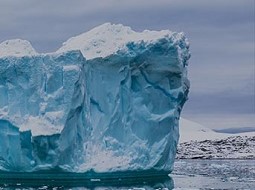
Northumbria's academics are studying the future of ice sheets and glaciers worldwide in a warming world. This involves understanding the causes of ongoing changes in Antarctica, Greenland and alpine areas, as well as assessing future changes and resulting impacts on human environments globally.
This is the place to find all the latest news releases, feature articles, expert comment, and video and audio clips from Northumbria University

Northumbria University News is packed full of news and features covering everything from research projects and business partnerships to student and staff awards.
Latest News and Features

New Doctoral Training Programme will tackle key polar science questions with a reduced carbon footprint
The Net Zero Polar Science (NZPS) Doctoral Training Programme (DTP) has welcomed its first…

New Student Health Hub brings joint health and wellbeing support
A new drop-in service is bringing health and wellbeing support for students at both Newcastle…

Researchers aim to grow optical fibres using biology instead of machinery
A new project led by Northumbria University aims to grow optical fibres using proteins, mimicking…

Training the next generation of space scientists
Northumbria University has hosted a major international workshop, bringing together leading…
.png?modified=20261006102851)
International design competition to grow the colour of the future
Researchers at Northumbria University and Imperial College London have launched an international…

Northumbria graduates celebrated at North East Business Awards
Graduate entrepreneurs from Northumbria University are celebrating after winning recognition…

How facial recognition failures harm people with facial differences
Researchers at Northumbria University's Centre for Responsible AI are working with Face Equality…

New Master Research Agreement strengthens commitment to cutting-edge research and innovation
Northumbria University and Lockheed Martin Space UK have signed a new Master Research Agreement,…
More events
Upcoming events

Next Stop Northumbria
Europa Hotel
-
The Past We Inherit. The Future We Build: Better Decisions Happen Together
The Great Hall, Sutherland Building
-
Next Stop Northumbria
Manchester Marriott Hotel Piccadilly
-
