
Scientists have come a step closer to understanding how collisionless shock waves – found throughout the universe – are able to accelerate particles to extreme speeds.
 These shock waves are one of nature's most powerful particle
accelerators and have long intrigued scientists for the role they play in
producing cosmic rays – high-energy particles that travel across vast distances
in space.
These shock waves are one of nature's most powerful particle
accelerators and have long intrigued scientists for the role they play in
producing cosmic rays – high-energy particles that travel across vast distances
in space.
The research, published today in Nature Communications, combines satellite observations from NASA’s MMS (Magnetospheric Multiscale) and THEMIS/ARTEMIS missions with recent theoretical advancements, offering a comprehensive new model to explain the acceleration of electrons in collisionless shock environments.
The paper, ‘Revealing an Unexpectedly Low Electron Injection Threshold via Reinforced Shock Acceleration’, was written by a team of international academics, led by Dr Savvas Raptis of the Johns Hopkins University Applied Physics Laboratory, in the USA, and in collaboration with Northumbria University’s Dr Ahmad Lalti.
This research addresses a long-standing puzzle in astrophysics – how electrons reach extremely high, or relativistic, energy levels.
For decades, scientists have been trying to answer a crucial question in space physics: What processes allow electrons to be accelerated to relativistic speeds?
The main mechanism to explain acceleration of electrons to relativistic energies is called Fermi acceleration or Diffusive Shock Acceleration (DSA). However, this mechanism requires electrons to be initially energized to a specific threshold energy before getting efficiently accelerated by DSA.
Trying to address how electrons achieve this initial energy is known as ‘the injection problem’.
 This new study provides key insights into the electron
injection problem, showing that electrons can be accelerated
to high energies through the interaction of various processes across multiple
scales.
This new study provides key insights into the electron
injection problem, showing that electrons can be accelerated
to high energies through the interaction of various processes across multiple
scales.
Using real-time data from the MMS mission, which measures the interaction of Earth’s magnetosphere with the solar wind, and the THEMIS/ARTEMIS mission, which studies the upstream plasma environment near the Moon, the research team observed a large scale, time dependent (i.e. transient) phenomenon, upstream of Earth's bow shock, on December 17, 2017.
During this event, electrons in Earth’s foreshock region – an area where the solar wind is predisturbed by its interaction with the bow shock – reached unprecedented energy levels, surpassing 500 keV.
This is a striking result given that electrons observed in the foreshock region are typically found at energies ~0.1-1.
This research suggests that these high-energy electrons were generated by the complex interplay of multiple acceleration mechanisms, including the interaction of electrons with various plasma waves, transient structures in the foreshock, and Earth's bow shock.
All of those mechanisms act together to accelerate electrons from low energies ~ 1keV up to relativistic energies reaching the observed 500 keV, resulting in a particularly efficient electron acceleration process.
By refining the shock acceleration model, this study provides new insight into the workings of space plasmas and the fundamental processes that govern energy transfer in the universe.
As a result, the research opens new pathways for understanding cosmic ray generation and offers a glimpse into how phenomena within our solar system can guide us to understand astrophysical processes throughout the Universe.
 Dr Raptis believes that studying phenomena across different
scales is crucial for understanding nature. “Most of our research focuses on
either small-scale effects, like wave-particle interactions, or large-scale
properties, like the influence of solar wind,” he says.
Dr Raptis believes that studying phenomena across different
scales is crucial for understanding nature. “Most of our research focuses on
either small-scale effects, like wave-particle interactions, or large-scale
properties, like the influence of solar wind,” he says.
“However, as we demonstrated in this work, by combining phenomena across different scales, we were able to observe their interplay that ultimately energize particles in space.”
Dr Ahmad Lalti added: “One of the most effective ways to deepen our understanding of the universe we live in is by using our near-Earth plasma environment as a natural laboratory.
“In this work, we use in-situ observation from MMS and THEMIS/ARTEMIS to show how different fundamental plasma processes at different scales work in concert to energize electrons from low energies up to high relativistic energies.
 “Those fundamental processes are not restricted to our solar system and are expected to occur across the universe.
“This makes our proposed framework relevant for better understanding electron acceleration up to cosmic-ray energies at astrophysical structures light-years away from our solar system, such as at other stellar systems, supernovae remnants, and active galactic nuclei.”
The paper ‘Revealing an Unexpectedly Low Electron Injection Threshold via Reinforced Shock Acceleration’ has been published today (Monday 13 January 2025) in Nature Communications (DOI 10.1038/s41467-024-55641-9).
Dr Ahmad Lalti is part of a distinguished group of researchers at Northumbria University, including multiple fellows and award recipients, who are advancing the frontiers of solar and space physics.
Northumbria collaborates extensively with partners including UK Research and Innovation, the UK Space Agency, the UK Met Office, and over 40 other industrial partners on cutting edge solar and space physics research, as well as a multitude of other specialist areas, from satellite communications and space physiology to earth observation and space law and policy.
Last year the University announced ambitious plans to develop a £50 million space skills, research and development centre, set to transform the UK space industry. The North East Space Skills and Technology centre (NESST) is expected to directly support the creation of over 350 jobs and inject over £260 million into the North East economy over the next 30 years, immediately becoming a catalyst for the wider development of the UK space sector in the North East region.
For more information about Dr Lalti’s work and the Solar and Space Physics research group at Northumbria, visit the University's Solar and Space Physics webpage.
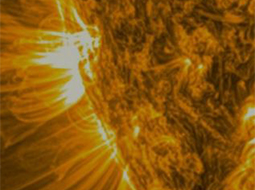
Northumbria University is powering the next generation of space innovation. Learn more about our expert academics, world class research and state of the art facilities.
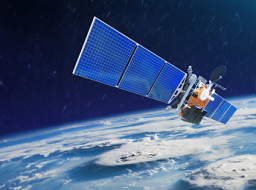
Our North East Space Skills and Technology Centre will be a state of the art £50M facility developed by Northumbria, with investment from the UK Space Agency and the space and satellite division of industry giant Lockheed Martin.
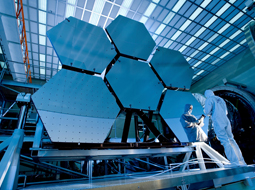
Department of Mathematics, Physics and Electrical Engineering
This department encompasses all of our work in Mathematics, Statistics and Physics including Astrophysics, Electrical and Electronic Engineering, Energy, Smart Materials, Microelectronics and Communications.

Northumbria’s Solar and Space researchers work to understand the physics of the Sun and all aspects of the solar-terrestrial connection to improve space weather forecasting.
This is the place to find all the latest news releases, feature articles, expert comment, and video and audio clips from Northumbria University

Northumbria University News is packed full of news and features covering everything from research projects and business partnerships to student and staff awards.
Latest News and Features
.png?modified=20261006102851)
International design competition to grow the colour of the future
Researchers at Northumbria University and Imperial College London have launched an international…

Northumbria graduates celebrated at North East Business Awards
Graduate entrepreneurs from Northumbria University are celebrating after winning recognition…

How facial recognition failures harm people with facial differences
Researchers at Northumbria University's Centre for Responsible AI are working with Face Equality…

New Master Research Agreement strengthens commitment to cutting-edge research and innovation
Northumbria University and Lockheed Martin Space UK have signed a new Master Research Agreement,…

Speeding glaciers drive half a century of polar ice loss
The longest satellite record ever assembled shows that Greenland and Antarctica have lost 11.3…

Northumbria physicist elected Fellow of the Institute of Physics
Dr Juna Sathian, an Associate Professor at Northumbria University, has been elected a Fellow…

Northumbria helps shape national plan to boost graduate employability
Northumbria University has played a key role in shaping a new national plan designed to help…

Northumbria researcher joins appeal to Downing Street on free school meals and holiday support
A Northumbria University academic, whose research has played a key role in bringing breakfast…
More events
Upcoming events

Specialist Teaching Assistant Degree Apprenticeship - In-person Information Session
Coach Lane Campus
-

Next Stop Northumbria
Europa Hotel
-
The Past We Inherit. The Future We Build: Better Decisions Happen Together
The Great Hall, Sutherland Building
-
Next Stop Northumbria
Manchester Marriott Hotel Piccadilly
-
