
-
Study
-
Quick Links
- Open Days & Events
- Fixed Block Degrees
- Real-World Learning
- Unlock Your Potential
- Tuition Fees, Funding & Scholarships
- Discover The Bridge
- Clearing 2026
-
Undergraduate
- Application Guides
- UCAS Exhibitions
- Extended Degrees
- School & College Outreach
- Parents & Guardians
-
Postgraduate
- Application Guide
- Postgraduate Research Degrees
- Flexible Learning
- Change Direction
- Register your Interest
-
Student Life
- Students' Union
- The Hub - Student Blog
- Accommodation
- Northumbria Sport
- Support for Students
-
Learning Experience
- Real-World Learning
- Research-enriched learning
- Graduate Futures
- The Business Clinic
- Study Abroad
-
-
International
International
View our Global Footprint-
International Students
- Northumbria and your Country
- International Student Events
- Application Guide
- Entry Requirements and Education Country Agents
- Global Offices and Regional Teams
- English Requirements
- English Language Centre
- International student support
- Cost of Living
-
International Fees and Funding
- International Undergraduate Fees
- International Undergraduate Funding
- International Masters Fees
- International Masters Funding
- International Postgraduate Research Fees
- International Postgraduate Research Funding
- Useful Financial Information
-
International Partners
- Agent and Representatives Network
- Global Partnerships
- Global Community
-
International Mobility
- Study Abroad
- Information for Incoming Exchange Students
-
-
Business
Business
Northumbria University is proud to offer a range of Professional, Statutory and Regulatory Body (PSRB) approved & accredited courses and programmes. Explore our list of courses and programmes under our Education and Training page.
More on our Business Services-
Business Quick Links
- Contact Us
- Business Events
- Research and Consultancy
- Education and Training
- Workforce Development Courses
- Join our mailing list
-
-
Research
Research
Northumbria is a research-rich, business-focused, professional university with a global reputation for academic quality. We conduct ground-breaking research that is responsive to the science & technology, health & well being, economic and social and arts & cultural needs for the communities
Discover more about our Research-
Quick Links
- Research Peaks of Excellence
- Academic Departments
- Research Staff
- Postgraduate Research Studentships
- Research Events
-
Research at Northumbria
- Interdisciplinary Research Themes
- Research Impact
- REF
- Partners and Collaborators
-
Support for Researchers
- Research and Innovation Services Staff
- Researcher Development and Training
- Ethics, Integrity, and Trusted Research
- University Library
- Vice Chancellors Fellows
-
Research Degrees
- Postgraduate Research Overview
- Doctoral Training Partnerships and Centres
- Academic Departments
-
Research Culture
- Research Culture
- Research Culture Action Plan
- Concordats and Commitments
-
-
About Us
-
About Northumbria
- Our Strategy
- Our Staff
- Our Schools
- Place and Partnerships
- Leadership & Governance
- University Services
- Northumbria History
- Contact us
- Online Shop
-
-
Alumni
Alumni
Northumbria University is renowned for the calibre of its business-ready graduates. Our alumni network has over 253,000 graduates based in 178 countries worldwide in a range of sectors, our alumni are making a real impact on the world.
Our Alumni - Work For Us
Satellite swarm to provide ‘missing link’ between space weather and space debris
Satellite technology developed by Northumbria University scientists has been adapted for a new, European Space Agency (ESA) funded mission, which will see a “swarm” of satellites sent into space to address the growing threat of space debris.
News of the project comes after the US government recently issued its first ever fine to a company for leaving space junk orbiting the Earth.
Space debris poses a huge problem for global communication systems and space exploration efforts. Now, the University of Warwick-led ‘Revealing the Orbital and Atmospheric Responses to Solar activity’ (ROARS) project, aims to tackle the problem with a “swarm” of satellites.
By distributing scientific instruments across multiple smaller inter-linked spacecraft, a “swarm” will possess observational capabilities far in excess of a standard, large satellite.
The mission idea has led to a 26 institution-strong consortium from across nine countries, with a core team leading the study from Northumbria, Warwick, Birmingham, Bath, UCL, Stuttgart, Imperial and Calgary universities, alongside industrial partner, OpenCosmos, the National Centre for Atmospheric Research, USA, the Space Research Institute, Austria, and Southwest Research Institute in the USA.
The team are examining how the swarm of small satellites known as CubeSats, which are about the size of a microwave, can fly in Low Earth Orbit (LEO), just 500 km above the Earth, a region home to exponentially growing satellite mega-constellations. They hope the swarm can provide a “missing” set of measurements necessary to accurately predict and prevent satellite and debris collisions.
Northumbria University is a leading centre for CubeSat research and earlier this year was awarded £5 million from the UK Space Agency to develop a new laser-based CubeSat system, which has the potential to transform the satellite communications industry.
The system being designed for that project will also be used in the laser ranging system of the ROARS CubeSat – providing an alternative use for this innovative technology.
The Northumbria University CubeSat team is led by solar physicist Professor Eamon Scullion. Speaking about ROARS, he said: “The Northumbria laser communications instrument forms a critical part of the payload of ROARS, enabling unique space science measurements, through coordinating the relative positions of the satellites in its laser ranging camp ability, with millimetre precision. This is a great example of the many different functionalities of this technology, and we’re excited about its future potential.”
The multiple satellites feature a dizzying array of new technologies. These include the latest atmospheric and magnetic field sensors, state-of-the art global navigation satellite systems (including GPS) and inter-satellite laser communications. A further integral mission component is ground radar, laser and optical observations, including from University of Warwick’s SuperWASP observatory on La Palma, Canary Islands.
The team will investigate how satellite drag from the Earth’s upper atmosphere; a force on near-Earth orbiting satellites, is modulated by solar activity and space weather. When solar storms interact with the Earth’s magnetic field they are responsible for the impressive Northern and Southern Lights (Aurora Borealis and Aurora Australis), but they can also heat our upper atmosphere and play havoc with spacecraft trajectories.
In February 2022, 40 Starlink satellites were lost, due to the effects of successive solar storms which caused a large atmospheric expansion and increased atmospheric drag, and ultimately caused the satellites to burn up in the upper atmosphere.
Dr Ravindra Desai, of University of Warwick’s Centre for Fusion, Space & Astrophysics and Principal Investigator of the mission, said: “This mission concept seeks to comprehensively understand how space weather deposits energy into our upper atmosphere, and how this threatens the satellites we increasingly depend upon for our day-to-day lives.
“We hope this will provide a step change in our ability to safely use our space environment and enable ESA’s Terrae Novae vision to provide Low Earth Orbit as a safe haven for further exploration of the moon and Mars.”
A further important factor in the swarm design is the ability for collision avoidance manoeuvres and safe deorbit within five years at the end of life. This is important so that the swarm itself doesn’t contribute to the very problem it is trying to address.
ESA released the £86 million (€100 million) campaign for Innovative Mission Concepts Enabled by Swarms of CubeSats at the start of this year and received 74 submissions, from which seven were competitively selected for Phase 0 funding to develop their concepts towards a flight opportunity.
You can read the European Space Agency press releases here: ESA - Seven ways to use a CubeSat swarm and CubeSats for improving space safety.
Image credit: Debris objects - mostly debris - in low Earth orbit (LEO) - view over the equator. Copyright European Space Agency - ESA
Our North East Space Skills and Technology Centre will be a state of the art £50M facility developed by Northumbria, with investment from the UK Space Agency and the space and satellite division of industry giant Lockheed Martin.
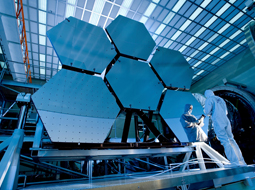
Northumbria’s Solar and Space researchers work to understand the physics of the Sun and all aspects of the solar-terrestrial connection to improve space weather forecasting.
This is the place to find all the latest news releases, feature articles, expert comment, and video and audio clips from Northumbria University
Northumbria University News is packed full of news and features covering everything from research projects and business partnerships to student and staff awards.
Latest News and Features
Record year for Northumbria as three academics named National Teaching Fellows
Three Northumbria University academics from across education, sport and the built environment…
Northumbria designers recognised at UK's biggest graduate showcase
Innovative designers and makers from Northumbria University have won a string of awards and…
Building bridges between science and Westminster: a Northumbria researcher's view from Parliament
The impact of research and technical expertise at Northumbria University has been highlighted…
Rare Norman Cornish painting donated to Northumbria University
A rare early painting by celebrated North East artist Norman Cornish has been donated to Northumbria…
Northumbria brings Westminster together to confront the nationwide opportunity gap
Northumbria University convened parliamentarians, policymakers, employers and sector leaders…
Students support growth of County Durham community hub
Students from Northumbria University’s Business Clinic are helping a County Durham church to…
Northumbria researcher takes Indian cinema legend to major international showcases
A Northumbria University academic curated a major retrospective of one of India's most influential…
New partnership will bridge the gap and open doors for adult learners at Northumbria University
Northumbria University is launching The Bridge, a flexible route into higher education for…
Upcoming events
NU-NHSA Launch Event
Northumbria University
-