
Northumbria University has hosted a major international workshop, bringing together leading scientists and early-career researchers from around the world to study the Sun and the particles it sends into space.
This is the first time the S³PARK Workshop, which stands for Synergy between Spacecraft observations and Simulations of Particle Acceleration, Reconnection, and Kinetic processes in turbulent plasmas, has taken place.
 The event brought together
instrument principal investigators (PIs) from European Space Agency (ESA) and NASA missions, as well as world-leading
experts in spacecraft observations and supercomputer simulations, and
early-career researchers.
The event brought together
instrument principal investigators (PIs) from European Space Agency (ESA) and NASA missions, as well as world-leading
experts in spacecraft observations and supercomputer simulations, and
early-career researchers.
Instrument PIs are the scientists who lead a specific instrument on a spacecraft from initial design through to launch and the analysis of the data it sends back, acting as the main point of contact between the science team, engineers, and space agencies.
The workshop focused on plasma physics – the study of the charged particles that stream from the Sun as the solar wind, reaching speeds of up to 800km per second.
Understanding these particles is important because when bursts of them reach Earth, they can disturb the planet's protective magnetic field and upper atmosphere, disrupting satellite communications, GPS signals and electrical grids – all of which have been recognised by the UK government as a national risk.
There are currently over 20 dedicated solar and heliospheric missions from ESA and NASA simultaneously gathering data about the Sun and the space environment surrounding Earth – an unprecedented level of scientific capability.
The UK plays a leading role in many of them, building on decades of expertise in space plasma instrumentation dating back to earlier missions such as Cluster and THEMIS.
The workshop discussed instruments, data, and the latest scientific breakthroughs from several key space missions. These included:
- Parker Solar Probe, which has flown closer to the Sun than any spacecraft in history, penetrating the solar corona
- Solar Orbiter, which combines high-resolution remote imaging of the Sun, including unprecedented views of its polar regions, with in-situ measurements
- Plasma Observatory, which has been recently recommended for selection as ESA's 7th Medium-class mission (expected launch 2039) and comprises seven identical spacecraft designed to study particle energisation and energy transport in Earth's near-space environment.
This convergence of missions, combining theoretical models, supercomputer simulations, and real-time spacecraft data, offers a unique opportunity to understand fundamental processes in plasma physics that drive space weather and shape the heliosphere.
The S³PARK Workshop exemplifies this era, bringing together international experts to synthesize insights from multiple missions and advance understanding of these critical processes at an unprecedented pace and scale.
Space missions generate huge amounts of data but understanding what that data means often depends on numerical simulations – computer models that recreate the physical conditions found in space, allowing scientists to test theories, fill in gaps between spacecraft measurements, and predict what future missions might find.
 Event organiser Dr Luca Franci, a Royal Society University Research Fellow
at Northumbria University, said that while missions typically receive funding
to build and run their instruments, the modelling work needed to make full
sense of the data they return is often overlooked.
Event organiser Dr Luca Franci, a Royal Society University Research Fellow
at Northumbria University, said that while missions typically receive funding
to build and run their instruments, the modelling work needed to make full
sense of the data they return is often overlooked.
He explained: “When a new space mission is launched, there's usually funding to work with the instrument teams, but very little for the people who need to build realistic computer models that help interpret the data those instruments send back.
“Simulations can be overlooked, even though they're essential for understanding what a spacecraft is measuring, and for designing the next generation of missions.”
Because there are so many different simulation methods and software tools in use, groups around the UK and the world often don't have the chance to compare notes or share the significant volumes of data and analysis they each produce.
The workshop was designed to bring observational and modelling communities into the same room, including bringing some of the scientists behind the instruments themselves to hear directly what data and simulations researchers need.
The programme included keynote talks on mission science goals and results, overviews of the main numerical modelling tools in use internationally, and dedicated discussion sessions exploring whether a shared database could be developed to let research groups pool data, resources and even funding proposals in future.
Early-career researchers, who typically specialise in either spacecraft observations or numerical modelling but not both, were given training and lectures spanning both disciplines over the course of the week, with the final day dedicated entirely to hands-on sessions and group discussions for early-career scientists.
 Stuart Bale, world-leading space plasma physicist at UC Berkeley and PI
of the FIELDS instrument on NASA's Parker Solar Probe, said: “The S³PARK workshop was a perfect confluence of numerical simulation experts and
leaders in the field of spacecraft measurements. The young scientists who were
present were exposed to the cutting edge of the fields and enjoyed interactions
with its leaders.”
Stuart Bale, world-leading space plasma physicist at UC Berkeley and PI
of the FIELDS instrument on NASA's Parker Solar Probe, said: “The S³PARK workshop was a perfect confluence of numerical simulation experts and
leaders in the field of spacecraft measurements. The young scientists who were
present were exposed to the cutting edge of the fields and enjoyed interactions
with its leaders.”
Dr Franci added: “Simulations allow us to visualise how turbulent plasma structures develop and evolve in three-dimensional space and how particles are heated and accelerated as they travel through them, but they're models.
“Spacecraft measurements give us the real thing, though only at a point or a few points at a time. Bringing these two types of data together is where the real insight comes from, and we wanted to train a new generation of scientists who are equally comfortable with both.”
 Several Northumbria
researchers took part. Dr Julia Stawarz, science co-investigator for NASA's Magnetospheric
Multiscale mission and member of the Science Study Team for ESA's Plasma
Observatory spoke about both missions. Dr Stephanie Yardley, an expert in Solar
Orbiter observations who leads some of its observing campaigns, gave an
overview of that mission's goals and results. Postdoctoral researcher Dr Zubair
Shaikh gave an overview of further missions including Wind, ACE and Cluster.
Several Northumbria
researchers took part. Dr Julia Stawarz, science co-investigator for NASA's Magnetospheric
Multiscale mission and member of the Science Study Team for ESA's Plasma
Observatory spoke about both missions. Dr Stephanie Yardley, an expert in Solar
Orbiter observations who leads some of its observing campaigns, gave an
overview of that mission's goals and results. Postdoctoral researcher Dr Zubair
Shaikh gave an overview of further missions including Wind, ACE and Cluster.
Dr Franci, a key member of the Numerical Simulation Working Group for Plasma Observatory, gave a keynote on comparing different simulation models with each other and with spacecraft observations, and led sessions on performing simulations on UK and international supercomputing resources for space science together with Northumbria’s incoming postdoctoral researcher Pranab Deka and Northumbria’s Visiting Scholar Emanuele Papini from the University of Florence.
 In total, 35 researchers
took part, from international institutions including Ruhr University Bochum in
Germany, KU Leuven in Belgium, the University of Turin, the University of
Florence and the National Institute of Astrophysics INAF in Italy, the Astronomical Institute of the Czech
Academy of Sciences, INPE in Brazil, and UC Berkeley in the US, as well as the
UK's Imperial College London, UCL's Mullard Space Science Laboratory, Queen
Mary University of London, and the universities of Southampton, Durham and St
Andrews.
In total, 35 researchers
took part, from international institutions including Ruhr University Bochum in
Germany, KU Leuven in Belgium, the University of Turin, the University of
Florence and the National Institute of Astrophysics INAF in Italy, the Astronomical Institute of the Czech
Academy of Sciences, INPE in Brazil, and UC Berkeley in the US, as well as the
UK's Imperial College London, UCL's Mullard Space Science Laboratory, Queen
Mary University of London, and the universities of Southampton, Durham and St
Andrews.
Silvia Ferro, a PhD student working on simulations at KU Leuven, said: “The S3PARK workshop gave me useful ideas on how to compare simulation results with spacecraft observations, and which diagnostics and quantities may be most relevant for this task. It also provided a very friendly and interactive environment, which made it easy to exchange ideas and build connections that I hope to maintain and develop into future collaborations.”
 Zubair Shaikh, a
postdoctoral researcher working on spacecraft observations at Northumbria University
added: “The discussions helped me think more clearly about how to test my
observational results against simulation results. They also opened
possibilities for future research visits and seminars. I think these
connections could be very useful for developing collaborations, joint projects,
and new research directions in the future.”
Zubair Shaikh, a
postdoctoral researcher working on spacecraft observations at Northumbria University
added: “The discussions helped me think more clearly about how to test my
observational results against simulation results. They also opened
possibilities for future research visits and seminars. I think these
connections could be very useful for developing collaborations, joint projects,
and new research directions in the future.”
One of the central aims of the workshop was to form a stronger and more cohesive research community, not only by fostering collaboration and advancing the science, but also by actively promoting inclusivity and diversity.
 Dr Imogen Gingell, a Royal Society University Research Fellow at the
University of Southampton, exemplified this multifaceted commitment. Dr Gingell
is an accomplished researcher in both modelling and spacecraft observations,
and she delivered a keynote talk on the analysis of collisionless shocks – abrupt
discontinuities in plasma conditions that are central to understanding space
weather phenomena.
Dr Imogen Gingell, a Royal Society University Research Fellow at the
University of Southampton, exemplified this multifaceted commitment. Dr Gingell
is an accomplished researcher in both modelling and spacecraft observations,
and she delivered a keynote talk on the analysis of collisionless shocks – abrupt
discontinuities in plasma conditions that are central to understanding space
weather phenomena.
Beyond her scientific contributions, Dr Gingell also shared her perspective on LGBTQIA+ accessibility in space physics, providing valuable insights on fostering a more welcoming and inclusive research environment.
Dr Franci said: “We believe that building a more diverse and welcoming community is as crucial as advancing the science itself, and it matters that we model this commitment for the next generation of space scientists.”
The workshop and attendee costs were funded through Dr Franci's Royal Society University Research Fellowship titled Thermal, suprathermal, and energetic particle dynamics in space plasmas.
Additional financial support came from the Royal Astronomical Society, which waived registration fees for all early-career scientists, and from UK Research and Innovation's Science and Technology Facilities Council (STFC), which covered travel and accommodation costs for four UK-based early-career scientists.
Dr Franci said: “The support from the Royal Society, the Royal Astronomical Society and STFC meant that every early-career researcher who wanted to attend could do so without worrying about the cost of registration, travel or accommodation. That mattered to me, because these are exactly the researchers we most need to bring into the field.”
The S³PARK Workshop is planned to run three times over the course of his eight-year fellowship, although feedback from attendees suggests strong appetite for it to become an annual fixture.
Dr Franci is a Royal Society University Research Fellow in Northumbria's Solar and Space Physics research group, based within the School of Engineering, Physics and Mathematics.
The workshop took place in the run-up to World Space Week, which takes place this week (4-10 October) and ahead of the opening of Northumbria's new North East Space Skills and Technology Centre (NESST).
NESST is a state of the art £50m facility developed by Northumbria, with investment from the UK Space Agency and the space and satellite division of industry giant Lockheed Martin.
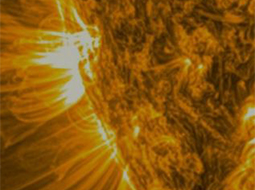
Northumbria University is powering the next generation of space innovation. Learn more about our expert academics, world class research and state of the art facilities.
Our North East Space Skills and Technology Centre will be a state of the art £50M facility developed by Northumbria, with investment from the UK Space Agency and the space and satellite division of industry giant Lockheed Martin.

North East Space Communications Accelerator is a £2.5M EPSRC funded initiative advancing resilient space communications.
Join us in powering the next generation of space innovation. Our new BEng Aerospace Satellite Engineering course has been developed by world-leading academics and industry partners to equip graduates with the key skills required to work and thrive within the rapidly growing space sector.
Join us in powering the next generation of space innovation. Our new MSc in Aerospace Satellite Engineering course has been developed by world-leading academics and industry partners to equip postgraduates with the advanced knowledge and skills required to work and thrive within the rapidly growing space sector.
At Northumbria Engineering, Physics and Mathematics are co-located in one ambitious, future-facing school.

Northumbria’s Solar and Space researchers work to understand the physics of the Sun and all aspects of the solar-terrestrial connection to improve space weather forecasting.
This is the place to find all the latest news releases, feature articles, expert comment, and video and audio clips from Northumbria University
Latest News and Features

Training the next generation of space scientists
Northumbria University has hosted a major international workshop, bringing together leading…
.png?modified=20261006102851)
International design competition to grow the colour of the future
Researchers at Northumbria University and Imperial College London have launched an international…

Northumbria graduates celebrated at North East Business Awards
Graduate entrepreneurs from Northumbria University are celebrating after winning recognition…

How facial recognition failures harm people with facial differences
Researchers at Northumbria University's Centre for Responsible AI are working with Face Equality…

New Master Research Agreement strengthens commitment to cutting-edge research and innovation
Northumbria University and Lockheed Martin Space UK have signed a new Master Research Agreement,…

Speeding glaciers drive half a century of polar ice loss
The longest satellite record ever assembled shows that Greenland and Antarctica have lost 11.3…

Northumbria physicist elected Fellow of the Institute of Physics
Dr Juna Sathian, an Associate Professor at Northumbria University, has been elected a Fellow…

Northumbria helps shape national plan to boost graduate employability
Northumbria University has played a key role in shaping a new national plan designed to help…
More events
Upcoming events

Specialist Teaching Assistant Degree Apprenticeship - In-person Information Session
Coach Lane Campus
-

Next Stop Northumbria
Europa Hotel
-
The Past We Inherit. The Future We Build: Better Decisions Happen Together
The Great Hall, Sutherland Building
-
Next Stop Northumbria
Manchester Marriott Hotel Piccadilly
-
