
ReNU is creating a pipeline of highly skilled doctoral graduates that will drive forward innovation in small scale renewable and sustainable distributed energy.
Please click on the drop downs below for further information about our Cohort 2 alumni and their research projects.
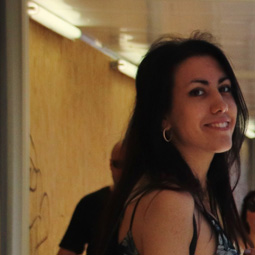
Melissa Poma
I completed a Bachelor’s Degree in Biological Sciences (2017) at the University of Siena, and a Master’s Degree in Vegetal and Microbial Biotechnologies (2019) at the University of Pisa. During my Masters, I had the great opportunity to work in a highly-advanced Synthetic biology group at the Max Planck Institute in Potsdam. Such experience allowed me to evaluate synthetic biology as a promising and powerful means to rewire native metabolic pathways in microorganisms, with the main purpose of tackling sustainability issues. By taking advantage of the knowledge acquired throughout my studies, I am looking forward to finding new cutting-edge strategies to produce bio-fuels molecules in tailor-made engineered bacteria. I will attempt to achieve this goal with the support of the ReNU program, which is giving me the big opportunity to be part of the change for building a new green economy.
Project Title – MicroFuelPro: Microbial fuel development framework using synthetic biology for next generation drop-in renewable fuel production
Supervisor – Dr Ulugbek Azimov
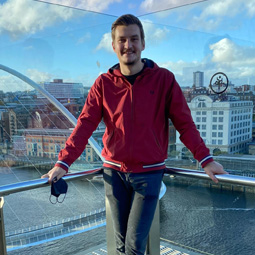
Luke Haworth
Post PhD Journey
I completed a post-doctoral research position in ESPCI – PSL in Paris where I studied single molecule super resolution microscopy. I then started and am currently in a post-doctoral research position at the University of Cambridge studying stratospheric aerosol injection for climate engineering.
PhD Journey
I have recently completed an MPhys (Hons) in Physics at Northumbria University where I had a strong interest within the area of research and led to me wanting to pursue a PhD. In my final year of my undergraduate study, my project revolved around the study of Smart Surfaces which is an area of great interest to me. As a follow on, I was drawn by the applications of these Smart Surfaces in the renewable energy sector as it is a fast growing and key area of research for the future. This has led to me pursuing a PhD with ReNU looking at the active and passive de-icing and anti-icing of wind turbines combining Smart Surfaces and Surface Acoustic Waves. My PhD was of further interest due to the industrial links and the extra training received due to the nature of being part of a CDT. Now as a student, I have now been able to volunteer to be the Student Representative for my Cohort at Northumbria which is a passion and something I would encourage any future students to volunteer for.
Project Title – Hybrid piezoelectric films and smart icephobic coatings with acoustic wave strategies for active ice protection in wind turbines
Supervisor – Prof Richard Fu
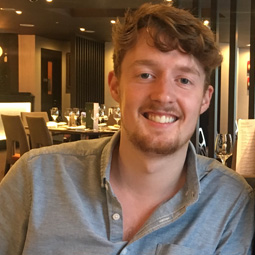
Michael Jones
In 2020 I graduated with a first-class honours MPhys degree from Northumbria University. It was during this course that I realised I would like to continue to develop my passion for photovoltaics and material science further in a PhD. In my third year of study I got my first insight into the fabrication and characterisation processes involved in the study of CZTS based photovoltaic devices during my undergraduate research project. It was this, along with modules such as advanced photovoltaics and semiconductor physics, that cemented my interests in this field of study. The ReNU CDT programme appealed to me as it combined both relevant academic training with increased networking abilities between three partner universities, all looking at making a positive environmental impact in multiple different approaches.
Project Title – Back contact engineering for high performance kesterite solar cells
Supervisor – Dr Yongtao Qu

Edward Land
Post PhD Journey
After my PhD I’ve been working for Apollo engineering as a naval architect working on offshore renewable projects, primarily cables and moorings analyses.
PhD Journey
Before starting my PhD, I completed my BEng (2019) and MSc (2020) in Naval Architecture at Newcastle University where I led the university’s Engineering Projects Society, heading projects on autonomous catamaran vessels and underwater remotely operated vehicles for various international competitions. During my degrees I wrote two dissertations involving mathematical modelling with the latter one in my final year looking at the dynamic response prediction of a vessel and applying it to a probabilistic capsize prediction tool. This has led me to my current project working with the Offshore Renewable Energy Catapult in developing a numerical programme to predict the dynamic responses of a Floating Offshore Wind Turbine (FOWT), considering the effects of aerodynamics, hydrodynamics, structural elasticity, mooring lines and control systems, their associated loads and how each component interacts with the others.
Project Title – Flexible Coupled Multi-Body Dynamic Research of Floating Offshore Wind Turbines
Supervisor – Prof Zhiqiang Hu, Dr Rose Norman & Dr Chong Ng

Reece Paterson
I obtained my integrated masters degree in chemistry from Newcastle University, where I was involved in several research projects. Notably, in my third year I completed an RSC supported project on the total synthesis of natural products, which developed my interest in solving complex problems. From there I completed my masters project where we used ionic liquid-like polymeric supports to stabilize metal nanoparticles for catalysis. My PhD project with ReNU allows me to continue my masters project and to expand the scope to address the real world problem of climate change by trying to convert CO2. For me, the ReNU programme was attractive as it provides CDT students with extensive knowledge of the renewable energy sector as well as the opportunity to make meaningful contacts within industry and academia.
Project Title – Exploiting Nanoparticles for Thermal and Light Driven Valorisation of Carbon Dioxide
Supervisor – Dr Simon Doherty
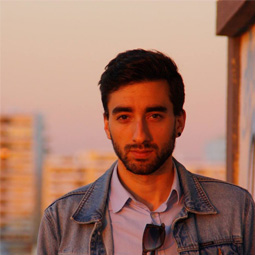
Sergio Serrano Blanco
I have been always interested in biotechnology and biological systems that’s why I decided to study first a BSc in Biotechnology followed by a BSc in Biochemistry and Molecular Biology between Spain and Portugal. I continued specializing myself by pursuing a MSc in Industrial Biotechnology awarded with distinction at University of Strathclyde. During these years I had the chance to carry out several projects in microalgae which became my main research interest. After the completion of my studies, I worked in industry for nearly three years as R&D technician and later as a Project Leader in the diagnostics sector. Then I decided to apply for the ReNU CDT PhD in Energy Materials at University of Newcastle. The ReNU PhD programme is a fantastic opportunity which bring together academia and industry along with an intensive training programme. As for my project, during the next years we will be looking at innovative 3D-printed materials to study their effect on the amount of microalgae obtained as well as treating aquaculture wastewater.
Project Title – Novel materials for intensified bioenergetic biomass production and aquaculture wastewater treatment
Supervisor – Prof Adam Harvey & Dr Sharon Velasquez Orta
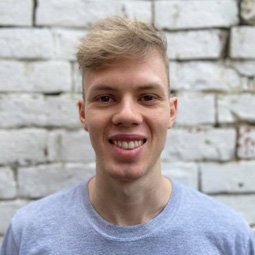
Jack Reeder
I graduated from the University of Nottingham (2018) with a BSc in Biology and have since completed a MSc in Biological and Bioprocess Engineering from the University of Sheffield (2020) – which further exposed the advantages of engineering and exploiting microorganisms for our benefit. My decision to undertake a PhD in Energy Materials was founded upon a passion for the progressive development of sustainable energy. Pursuing research into next generation Microbial Fuel Cells (MFC) is hugely attractive from an environmental aspect. This technology can support renewable electricity generation and simultaneous wastewater treatment. Between universities, I gained industrial experience which involved the commercial production of a functional polymerizable monomer for a medical device. Building upon my experience with functional polymers, my project aims to advance MFC efficiency moving towards a green economy. The ReNU CDT initiative boasts a multi-disciplinary, collaborative research programme with additional innovation and business training available which was an extremely appealing prospect.
Project Title – Bacteria Recognition-Extraction from Wastewater (BREW) for next generation Microbial Fuel Cell Technology
Supervisor – Dr Marloes Peeters, Dr Elizabeth Heidrich & Dr Matthew Unthank
Page last updated 23/07/26
