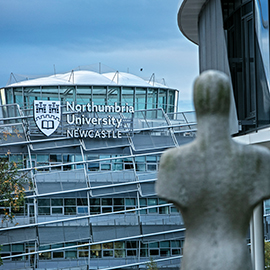
Business and Management MSc
16 Months Full-Time | January Start
Option for Placement Year
Option for Study Abroad

International
View our Global FootprintBusiness
Northumbria University is proud to offer a range of Professional, Statutory and Regulatory Body (PSRB) approved & accredited courses and programmes. Explore our list of courses and programmes under our Education and Training page.
More on our Business ServicesResearch
Northumbria is a research-rich, business-focused, professional university with a global reputation for academic quality. We conduct ground-breaking research that is responsive to the science & technology, health & well being, economic and social and arts & cultural needs for the communities
Discover more about our ResearchAlumni
Northumbria University is renowned for the calibre of its business-ready graduates. Our alumni network has over 253,000 graduates based in 178 countries worldwide in a range of sectors, our alumni are making a real impact on the world.
Our AlumniIf you’d like to receive the latest updates from Northumbria about our courses, events, finance & funding then enter your details below.
* At Northumbria we are strongly committed to protecting the privacy of personal data. To view the University’s Privacy Notice please click here
Option for Placement Year
Option for Study Abroad

This Newcastle based business and management masters is open to those from any undergraduate background and aims to develop your leadership and management capability by enhancing your knowledge of international business management theory, whilst expanding cultural and ethical awareness.
There is a strong focus on sustainability and corporate social responsibility. You will explore how international organisations seek competitive advantage through innovation, evaluating sustainable strategies to promote business growth in a responsible way.
Benefiting from learning in exceptional teaching facilities, you will cover a range of management and leadership concepts that will consider positive and responsible change within organisations, the impact of change on individuals and issues of resilience and sustainability.
This course also aims to develop contemporary skills that will enable you to develop effective strategies to successfully build sustainable, digital enterprises. You will have the opportunity to attend a residential where you will work collaboratively with peers, enhance your leadership and team-working abilities through increased self-awareness and knowledge of group processes.
The course culminates in either a dissertation, or consultancy project- tackling an issue faced by a real client, or if you prefer, a master's management enquiry project - working with others as a team to explore a business issue. These can be related to any business and management discipline, given the wide and varied content of this master's programme.
Graduates of this course can typically expect to go into professional and graduate management position. You may choose to start a career within an industry that is related to the subject that you studied during your first degree or you may prefer to take on a completely new challenge.
If you decide to start up your own business, it’s good to know that the combined turnover of our graduates’ start-up companies is higher than that of any other UK university.
The Business with Management Masters could also lead you to a postgraduate research degree such as an MPhil, PhD and Professional Doctorate.
Newcastle Business School is accredited by the prestigious Association to Advance Collegiate Schools of Business (AACSB). According to AACSB, “Approximately 6% of the world's schools offering business degree education have achieved AACSB accreditation, demonstrating a commitment to high-quality, rigorous standards, innovation, and continuous process improvement”. Read more about our 'double' AACSB Accreditation.
Please note, we also offer a distance learning Business and Management MSc.

![]()
This Newcastle based business and management masters is open to those from any undergraduate background and aims to develop your leadership and management capability by enhancing your knowledge of international business management theory, whilst expanding cultural and ethical awareness.
There is a strong focus on sustainability and corporate social responsibility. You will explore how international organisations seek competitive advantage through innovation, evaluating sustainable strategies to promote business growth in a responsible way.
Benefiting from learning in exceptional teaching facilities, you will cover a range of management and leadership concepts that will consider positive and responsible change within organisations, the impact of change on individuals and issues of resilience and sustainability.
This course also aims to develop contemporary skills that will enable you to develop effective strategies to successfully build sustainable, digital enterprises. You will have the opportunity to attend a residential where you will work collaboratively with peers, enhance your leadership and team-working abilities through increased self-awareness and knowledge of group processes.
The course culminates in either a dissertation, or consultancy project- tackling an issue faced by a real client, or if you prefer, a master's management enquiry project - working with others as a team to explore a business issue. These can be related to any business and management discipline, given the wide and varied content of this master's programme.
Graduates of this course can typically expect to go into professional and graduate management position. You may choose to start a career within an industry that is related to the subject that you studied during your first degree or you may prefer to take on a completely new challenge.
If you decide to start up your own business, it’s good to know that the combined turnover of our graduates’ start-up companies is higher than that of any other UK university.
The Business with Management Masters could also lead you to a postgraduate research degree such as an MPhil, PhD and Professional Doctorate.
Newcastle Business School is accredited by the prestigious Association to Advance Collegiate Schools of Business (AACSB). According to AACSB, “Approximately 6% of the world's schools offering business degree education have achieved AACSB accreditation, demonstrating a commitment to high-quality, rigorous standards, innovation, and continuous process improvement”. Read more about our 'double' AACSB Accreditation.
Please note, we also offer a distance learning Business and Management MSc.

Level of Study
Postgraduate
Mode of Study
16 months Full Time
3 other options available
School
Newcastle Business School
Location
City Campus, Northumbria University
City
Newcastle
Start
January
Fees
Fee Information
Modules
Module Information
Discover the funding options available to you.

Scholarship Search Tool
Discover our available funding options.

Alumni Discount
Receive up to 20% off your course fees.

The Postgraduate Loan
More about the UK Government Loan.
At NBS we’re Business, but not as usual. Discover more.

Newcastle Business School

Real-World Learning: Consultancy Project
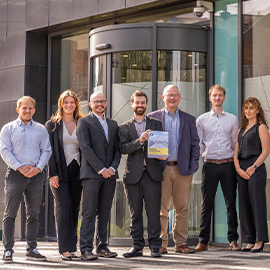
Students gain invaluable work experience with EY Newcastle, helping to drive apprentice recruitment
Read MoreNorthumbria business students develop branding strategy for OddBalls Apparel.

Read the news story.Team Northumbria Wins the 12th Greggs Marketing Challenge.

Read the news story.Northumbria named as a Principles for Responsible Management Education Champion.
Read the news story.Entrepreneurial student launches marine-based skincare products.

Read the news story.Your tutors will use a variety of teaching methods including lectures, seminars and workshops. As this is a master’s course there is a major element of independent learning and self-motivated reflection.
Teaching is backed up by a well-designed support system that helps ensure a successful learning journey. We make sure that extensive feedback, from both tutors and peers, is built into the course.
This course also includes a residential day for the leadership and team-building event, which is aimed at strengthening skills in team working, emotional and cultural intelligence, self-reflection, independent learning and critical thinking
Our assessment strategy is based on our understanding that everyone has different needs, strengths and enthusiasms. Assessment is based on course work and our methods will include essays, reports, group work, presentations, and the master’s dissertation or consultancy project.
Our academic teaching teams comprise experienced management practitioners and researchers who continue to be actively engaged in professional practice. To maintain their professional profile, our staff are actively engaged in consultancy, enterprise, organisational consultancy and research in areas such as supporting workforces through global crises, financial crime, ageing workforce, organisational psychology, social entrepreneurship, business ethics and corporate social responsibility. Our academics are also members of signature research groups that include digital business, strategic innovation and entrepreneurial leadership, and responsible business.
The involvement of our academics in these activities directly informs the content of modules we teach offering the chance to develop up-to-the-minute understanding of the challenges of complex, global workplaces.
At Newcastle Business School you’ll experience a first-class education in a world-class environment. From our social spaces and hub areas to lecture theatres and exhibition spaces, our facilities are exceptional. For example, the 24/7 university library achieves some of the highest levels of student satisfaction in the UK and has held the Cabinet Office accreditation for Customer Service Excellence since 2010.
We’re also committed to helping you make the most of Technology Enhanced Learning (TEL) by embedding it throughout the course. Tools such as the ‘Blackboard’ eLearning Portal and electronic reading lists are there to help you efficiently and thoroughly prepare for seminars and independent research. Lecture capture software means you can revise previously lectured material online in your time, as well as at your speed.
What’s more, there are plenty of opportunities to put your learning into practice. This includes the Business Clinic that provides student consultancy facilities to work with our clients in response to their business problem. Our clients are drawn from a range of organisations including multinationals, SMEs, not-for-profit charities and social enterprises from across the region and nationally.
![]()
Explore the outstanding facilities available at Newcastle Business School.
As a master’s student you’ll develop your research skills to a new and higher level. Your research supervisor will help you submit a proposal for your master’s dissertation or consultancy project and then discuss its development through to completion in the final semester.
If you decide on a master’s consultancy project, or management enquiry rather than a dissertation, you’ll still undertake primary and desk research. Through your reading, reflection and research, you’ll be expected to show a deep understanding of the issues that are involved in the client brief.
Throughout your Business Management Masters you’ll be an active participant in the on-going research agenda that’s at the heart of Newcastle Business School. With conferences and research events regularly taking place, and with staff discussing their own research as it relates to the topics you’ll study, there’s a strong emphasis on engaging in up-to-date enquiry-based learning.
Newcastle Business School has three formal research and distinctive signature areas supported by a set of dynamically inclusive and academic led research interest groups. These include: Strategic Innovation and Entrepreneurial Leadership, Responsible Business and Digital Business.
Discover more about current research projects at Newcastle Business School.
The course includes modules that are focused on developing global management competencies, leadership and management and leadership for responsible change. Topics during these modules include emotional intelligence, cultural awareness and the ability to work in diverse groups and teams, as well as project management and decision making.
To further enhance your employability, we offer the opportunity to undertake a master’s consultancy project, or management enquiry project as an alternative to the traditional dissertation. You’ll work in a small group, typically no more than five people, or on your own in the case of the management enquiry and tackle a live project from a host organisation under the mentoring of a member of our academic team. The project can be an excellent vehicle for you to relate theory to practice while developing key employability skills.
Our graduates typically go into professional and graduate management positions and, by the end of the course, you’ll be well-equipped to follow them. You may choose to start a career within an industry that’s related to the subject that you studied during your first degree or you may prefer to take on a completely new challenge.
If you decide to start up your own business, it’s good to know that the combined turnover of our graduates’ start-up companies is higher than that of any other UK university.
The Business Management Masters could also lead you to a postgraduate research degree such as an MPhil, PhD and Professional Doctorate.
Whatever you decide to do, you will have the transferable skills that employers expect from a master’s graduate from Northumbria University. These include the ability to tackle complex issues through conceptualisation and undertaking research, the ability to contribute to new processes and knowledge, and the ability to formulate balanced judgements when considering incomplete or ambiguous data.
Take a look at what Northumbria has to offer and discover what studying with us can do for you.
Applicants should normally have:
A minimum of a 2:2 honours degree or equivalent, or substantial experience of working in a business organisation.
International qualifications:
If you have studied a non UK qualification, you can see how your qualifications compare to the standard entry criteria, by selecting the country that you received the qualification in, from our country pages. Visit www.northumbria.ac.uk/yourcountry
English Language requirements:
International applicants are required to have a minimum overall IELTS (Academic) score of 6.5 with 5.5 in each component (or approved equivalent*).
*The university accepts a large number of UK and International Qualifications in place of IELTS. You can find details of acceptable tests and the required grades you will need in our English Language section. Visit www.northumbria.ac.uk/englishqualifications
Full UK Fee: £12,660
Tuition fees in the academic year 2027/28* will be £10,050. Fees are set in line with the UK Government's tuition fee cap. The University may increase fees in subsequent years in line with any changes to the tuition fee cap. Increases will be linked to inflation. For example, increases may be linked to RPIX (Retail Price Index excluding mortgage interest payments) Students will be notified of any increase ahead of it taking effect. Student fee loans rise in line with the tuition fees cap.
*if your course is longer than one year
Full International Fee: £21,500
This is the tuition fee for your first year of study. You should expect to pay tuition fees for every year of study. The University may increase fees in the second and subsequent years of your course at our discretion in line with any inflationary or other uplift. Students will be notified of any increase ahead of it taking effect.
Scholarships and Discounts
ADDITIONAL COSTS
TBC
* At Northumbria we are strongly committed to protecting the privacy of personal data. To view the University’s Privacy Notice please click here
Module information is indicative and is reviewed annually therefore may be subject to change. Applicants will be informed if there are any changes.
BM9718 -
Research Methods and Analytics for Business Practice (Core,20 Credits)
In this module you will learn about a comprehensive range of research methods and business analytics techniques. This will equip you with the knowledge and practical skills necessary for you to conduct research at Masters’ level and prepare you to complete a Master’s Dissertation, Consultancy Project or Management Enquiry. By the end of the module you will know how to apply both quantitative and qualitative data collection and business analysis techniques. In quantitative techniques you will learn about sampling, questionnaire design, statistical inference, and hypothesis testing while qualitative techniques covered will include methods such as interviewing and focus groups. Analysis methods such as content analysis and thematic analysis will also be covered. In addition, you will gain some understanding of research philosophy (positivism and interpretivism) and research ethics and you will be able to write a research proposal to bring these ideas together.
Furthermore, this module will provide clear, critical, and analysis of data, you will also be able to consider the use of analytics implementation skills, where you will be introduced to analytics software such as SPSS. SPSS statistics analysis is one of the powerful solutions that is designed to help businesses and researchers to solve problems by various methods (geospatial analysis, predictive analytics and hypothesis testing).
HR9737 -
Leadership and Management Development (Core,20 Credits)
This module engages you in personal and professional development in order that you develop and hone your teamworking, management and leadership skills, capabilities and attributes, and in so doing, enhance your employability. On this module, you will not only prepare for your first job after you graduate but also kickstart your commitment to life-long personal and professional learningThe module you will be supported in a self-analysis by a range of activities, including the completion of self-administered diagnostic tool-kits to demonstrate an increased self-awareness and self-understanding. This will also involve applying theoretical frameworks and researching a range of literature for a more in-depth understanding of self and the nature of social interactions. A key outcome of this process is how you will be able to exploit this development in order to lead, and manage, more effectively in your future careers.
The module contains activities enables you to build on your self-analysis and explore further your strengths, weaknesses and areas for development in the context of your career development plans. You will receive guidance on how to craft professional profilesand supporting documentation to meet the needs of employer. Your understanding of self helps you to understand the key issues and specific challenges in relation toemployability prospects in your target profession/industry/sector. This will also include the development of knowledge into the global graduate market, (including routes such as self-employment and developing your career with an existing employer) drawing upon local, national and international examples.
HR9738 -
Leadership for Responsible Change (Core,20 Credits)
This module critically explores managing and leading positive and responsible change within work organisations. While the focus is on planned approaches to changes, you will also develop an appreciation of emergent change through exploration of a range of concepts, models, and theoretical frameworks. You will compare types of change and processes to participatory change and stakeholder inclusion and engagement. You will also consider impacts of change on individuals and issues of resilience and sustainability.
More informationMO9704 -
Strategy and Marketing (Core,20 Credits)
Following the historical perspectives, contemporary development, emergent areas in marketing and the cross-functional business areas, this module takes a strategic view of marketing management. The aim is to introduce marketing at an advanced strategic level, enabling you to develop theoretical understanding, in order to interpret the theoretical understanding into practical application.The purpose is to support the development of knowledge and skills required for strategic analysis of market and key stakeholders to formulate sustainable marketing strategies.
A forward-thinking approach is adopted throughout the module, as you will have the opportunity to learn and discuss the theories and concepts that have been persistently influencing the evolving marketing dynamics. This module will cover three key areas of strategic marketing and business sustainability:
1) Understanding your market and developing marketing strategies:
• The transformation in marketing dynamics: Looking backward to move forward
• Marketing audit: Stakeholders as the key players in your market
• Competitive factors and strategic marketing
• A cross-cultural world: Understanding the contemporary buyers
• Customer value and new product development
• Pricing strategy
2) Implementation of strategies: Strategic marketing and sustainable competitive advantage
• Stakeholder relationship management and business sustainability
• Marketing mix and market segments
• Strategic communication: Image, reputation and brand positioning/re-positioning
• Resource-based view and sustainable competitive advantage: Outplaying competitors’ value proposition
• Influencing buyers’ decision: Implications of behavioural economics
• Digital marketing
• International marketing
3) Emerging areas in strategic marketing
• The ongoing changes in market dynamics
• Ethical consumers and green marketing
• Responsible marketing and the UN sustainable development goals
• Cross-functional implications of marketing and vice-versa
NX0477 -
NBS Masters Consultancy Project (Optional,60 Credits)
This option is offered as an alternative to the NBS Masters’ Dissertation on all 1-year MSc programmes and in the second semester of year 2 on the 2-year programme variants with Study Abroad and with Advanced Practice (if the students select an Internship in semester 1), again as a Dissertation alternative. It is also offered as alternative to the Management Investigation on the MBA.
On this consultancy based module you will enhance your individual effectiveness and employability skills by locating the learning and development in an organisational context. In doing so, you will promote personal and group development, commercial awareness, and a range of inter-personal, intellectual and practical skills and knowledge centred on and demonstrated through a group negotiated real-time work-based project.
The content of the management report will be unique. The nature and scope of the area of your investigation will be defined and agreed in collaboration with the organisation and the University supervisor. The syllabus will include:
• Conducting research in organisations.
• Identifying researchable questions.
• Consultancy and project management skills.
• Research methods and doing a literature review
• Presentation, communication and report writing skills.
• Analysing findings.
• Writing recommendations and action plans.
• Reflecting on work based experiential learning.
In undertaking this project based module, you will critically reflect and evaluate upon organisational practices and their relation with academic theory, and in doing so, provide practical and actionable recommendations through an investigative management report.
The assessment for your module consists of a Group Consultancy Report (7,000 words) and Final Client Presentation, weighted at 60%, alongside an Individual Assignment comprising a Literature Review (4000 words) and a Reflective Learning Statement (2,000 words), weighted at 40%.
NX0480 -
The Newcastle Business School Masters Dissertation (Optional,60 Credits)
In this module you will gain an understanding of the academic skills that are required to produce a Masters Dissertation. By the end of the module you will have written a 15000 word Masters dissertation. The areas included are:
• Justification for the choice of topic
• Appropriate understanding, awareness and critical analysis of existing and up to date literature evidenced by a comprehensive and well-referenced literature review with an extensive reference list
• Selection, justification and application of an appropriately rigorous methodology - including limitations of the approach selected
• Clear statement of the findings of the research
• Critical analysis of the findings
• Explicit links between the analysis and the conclusions supported by critical argument
• Evidence of original work or thought for example in the form or context of the data collected, analytical process or application of findings
NX9734 -
Masters' Management Enquiry (Optional,60 Credits)
The Masters’ Management Enquiry module is a student-led individual project that enables you to undertake a significant piece of assessed
work commensurate with a capstone module and is offered as an alternative to the Masters’ Dissertation and Masters’ Consultancy Project.
The module aims to provide you with an opportunity to demonstrate an authentic engagement with managers and/or professionals in your
discipline (this enquiry has to be discipline specific), and to integrate the knowledge you have developed during your programme to explore
the theory in practice. The learning on this module is experiential and problem based, where the focus is upon you discovering, probing and
questioning key practice-based issues. Through the module you will be offered the opportunity to develop and enhance key transferable
employability skills including; time management, project management, communication (written, aural and verbal), negotiation, persuasion and
influence, discovery, initiative, problem-solving and analysis.
The module has five thematic areas; explore, review, engage, reflect and connect. These form the key elements of the assessed submission
which is a single 15,000 word report.
Part A (35%, 5,000-5,500 words)
Explore: Interviewing a manager and/or professional in your discipline. In this interview you will either explore a key issue which you feel the
discipline is facing or, alternatively, explore with the manager or professional the key issues that they feel they are facing in practice. It is
expected that you will apply non-verbatim documented conversation and provide evidence of the key ideas emerging within the submitted
enquiry report (e.g. within the appendices).
Review: Critically examining the academic and practitioner literature to support the exploration, displaying an ability to critically assess and
appraise the knowledge of your discipline related to a specific key issue arising from your exploration.
Part B (65%, 9,500-10,000 words)
Engage: Displaying an authentic engagement with the discipline problem/issue identified in Part A, by collecting/generating and analysing
further live data (beyond the initial interview) regarding the discipline problem/issue. This live data may be primary data (e.g. further interviews
with, or questionnaire to, managers and/or professionals in practice) or secondary data (e.g. industry data). Application of appropriate,
ethically-considered, research methods and appropriate qualitative or quantitative data analysis.
Reflect and Connect: Demonstrating an ability to critically evaluate and reflect on the issues arising from the Management Enquiry.
Demonstrating how you have connected and fed-back to the participants of the Enquiry (usually the manager and/or participants) your key
findings to provide clear prioritised, well-justified, practical and actionable recommendations for change/enhancement/improvement to existing
practice to show how the recommendations would potentially affect workplace professional decision making.
SC7000 -
Skills for Academic Success in a UK University (Core – for International and EU students only,0 Credits)
You will develop your understanding of academic conventions in UK higher education aligned to your level of study, including expectations around critical analysis, structure, argumentation, evidencing, and referencing. The module focuses on developing communication strategies that will help you express your ideas clearly and coherently in written assignments and spoken activities. You will also reflect on your current academic and language skills and develop strategies for development ahead of your assessments.
More informationSM4022 -
Globalisation, Innovation and Sustainability (Core,20 Credits)
This 20-credit core module is delivered during the first semester of the MSc International Business Management and is aimed at you if you have prior business and management academic experience.
The aim of the module is to build on your prior academic knowledge of business management and explores the new post-recession economic and business environment. It aims to develop your academic knowledge and professional skills in evaluating sustainable strategic options for international organisations seeking competitive advantage through innovation. Contemporary but also traditional strategy formulation theoretical frameworks are presented within the module to develop you as critical thinkers and future practitioners.
The module is designed around five pillars: (i) developments in the new (post-global recession) economic and business environment; (ii) strategic options for international growth; (iii) innovation; (iv) leadership and change within an international/global business model; and (v) sustainability and corporate social responsibility (CSR).
SM9715 -
Innovation and Entrepreneurship (Core,20 Credits)
The module aims to provide you with knowledge and skills regarding the application of digital technologies in support of entrepreneurial activities, across the different stages of the entrepreneurial process (opportunity identification, start-up and scale-up). The module is delivered using interactive workshops, supported by an interactive discussion board, tutor supported, but permitting interaction with fellow students.
This module will cover the main aspects of the relationship between digital technologies and entrepreneurship:
• Opportunities and challenges of digital technologies for entrepreneurs,
• The skillset of digital entrepreneurs: entrepreneurial and digital skills,
• The impact of digital technologies on the creation and recognition of entrepreneurial opportunities,
• The start-up of digital enterprises: value creation, business models and funding strategies,
• The scale-up of digital enterprises: strategies to deal with regulation, competition and barriers to growth.
The module will lead you to the development of fundamental, contemporary skills for creating and developing digital enterprises. On completing the module, you will learn about the specific challenges of undertaking entrepreneurial activities in the context of digital markets and acquire the skills to develop effective strategies to build sustainable digital enterprises.
NX0477 -
NBS Masters Consultancy Project (Optional,60 Credits)
This option is offered as an alternative to the NBS Masters’ Dissertation on all 1-year MSc programmes and in the second semester of year 2 on the 2-year programme variants with Study Abroad and with Advanced Practice (if the students select an Internship in semester 1), again as a Dissertation alternative. It is also offered as alternative to the Management Investigation on the MBA.
On this consultancy based module you will enhance your individual effectiveness and employability skills by locating the learning and development in an organisational context. In doing so, you will promote personal and group development, commercial awareness, and a range of inter-personal, intellectual and practical skills and knowledge centred on and demonstrated through a group negotiated real-time work-based project.
The content of the management report will be unique. The nature and scope of the area of your investigation will be defined and agreed in collaboration with the organisation and the University supervisor. The syllabus will include:
• Conducting research in organisations.
• Identifying researchable questions.
• Consultancy and project management skills.
• Research methods and doing a literature review
• Presentation, communication and report writing skills.
• Analysing findings.
• Writing recommendations and action plans.
• Reflecting on work based experiential learning.
In undertaking this project based module, you will critically reflect and evaluate upon organisational practices and their relation with academic theory, and in doing so, provide practical and actionable recommendations through an investigative management report.
The assessment for your module consists of a Group Consultancy Report (7,000 words) and Final Client Presentation, weighted at 60%, alongside an Individual Assignment comprising a Literature Review (4000 words) and a Reflective Learning Statement (2,000 words), weighted at 40%.
NX0480 -
The Newcastle Business School Masters Dissertation (Optional,60 Credits)
In this module you will gain an understanding of the academic skills that are required to produce a Masters Dissertation. By the end of the module you will have written a 15000 word Masters dissertation. The areas included are:
• Justification for the choice of topic
• Appropriate understanding, awareness and critical analysis of existing and up to date literature evidenced by a comprehensive and well-referenced literature review with an extensive reference list
• Selection, justification and application of an appropriately rigorous methodology - including limitations of the approach selected
• Clear statement of the findings of the research
• Critical analysis of the findings
• Explicit links between the analysis and the conclusions supported by critical argument
• Evidence of original work or thought for example in the form or context of the data collected, analytical process or application of findings
NX9734 -
Masters' Management Enquiry (Optional,60 Credits)
The Masters’ Management Enquiry module is a student-led individual project that enables you to undertake a significant piece of assessed
work commensurate with a capstone module and is offered as an alternative to the Masters’ Dissertation and Masters’ Consultancy Project.
The module aims to provide you with an opportunity to demonstrate an authentic engagement with managers and/or professionals in your
discipline (this enquiry has to be discipline specific), and to integrate the knowledge you have developed during your programme to explore
the theory in practice. The learning on this module is experiential and problem based, where the focus is upon you discovering, probing and
questioning key practice-based issues. Through the module you will be offered the opportunity to develop and enhance key transferable
employability skills including; time management, project management, communication (written, aural and verbal), negotiation, persuasion and
influence, discovery, initiative, problem-solving and analysis.
The module has five thematic areas; explore, review, engage, reflect and connect. These form the key elements of the assessed submission
which is a single 15,000 word report.
Part A (35%, 5,000-5,500 words)
Explore: Interviewing a manager and/or professional in your discipline. In this interview you will either explore a key issue which you feel the
discipline is facing or, alternatively, explore with the manager or professional the key issues that they feel they are facing in practice. It is
expected that you will apply non-verbatim documented conversation and provide evidence of the key ideas emerging within the submitted
enquiry report (e.g. within the appendices).
Review: Critically examining the academic and practitioner literature to support the exploration, displaying an ability to critically assess and
appraise the knowledge of your discipline related to a specific key issue arising from your exploration.
Part B (65%, 9,500-10,000 words)
Engage: Displaying an authentic engagement with the discipline problem/issue identified in Part A, by collecting/generating and analysing
further live data (beyond the initial interview) regarding the discipline problem/issue. This live data may be primary data (e.g. further interviews
with, or questionnaire to, managers and/or professionals in practice) or secondary data (e.g. industry data). Application of appropriate,
ethically-considered, research methods and appropriate qualitative or quantitative data analysis.
Reflect and Connect: Demonstrating an ability to critically evaluate and reflect on the issues arising from the Management Enquiry.
Demonstrating how you have connected and fed-back to the participants of the Enquiry (usually the manager and/or participants) your key
findings to provide clear prioritised, well-justified, practical and actionable recommendations for change/enhancement/improvement to existing
practice to show how the recommendations would potentially affect workplace professional decision making.
The following alternative study options are available for this course:
Sep start
Sep, Jan start
Jan, Apr, Jul start
Our Applicant Services team will be happy to help. They can be contacted on 0191 406 0901 or by using our Contact Form.
Full time Courses are primarily delivered via on-campus face to face learning but could include elements of online learning. Most courses run as planned and as promoted on our website and via our marketing materials, but if there are any substantial changes (as determined by the Competition and Markets Authority) to a course or there is the potential that course may be withdrawn, we will notify all affected applicants as soon as possible with advice and guidance regarding their options. It is also important to be aware that optional modules listed on course pages may be subject to change depending on uptake numbers each year.
Contact time is subject to increase or decrease in line with possible restrictions imposed by the government or the University in the interest of maintaining the health and safety and wellbeing of students, staff, and visitors if this is deemed necessary in future.
Northumbria University is committed to developing an inclusive, diverse and accessible campus and wider University community and are determined to ensure that opportunities we provide are open to all.
We are proud to work in partnership with AccessAble to provide Detailed Access Guides to our buildings and facilities across our City, Coach Lane and London Campuses. A Detailed Access Guide lets you know what access will be like when you visit somewhere. It looks at the route you will use getting in and what is available inside. All guides have Accessibility Symbols that give you a quick overview of what is available, and photographs to show you what to expect. The guides are produced by trained surveyors who visit our campuses annually to ensure you have trusted and accurate information.
You can use Northumbria’s AccessAble Guides anytime to check the accessibility of a building or facility and to plan your routes and journeys. Search by location, building or accessibility feature to find the information you need.
We are dedicated to helping students who may require additional support during their student journey and offer 1-1 advice and guidance appropriate to individual requirements. If you feel you may need additional support you can find out more about what we offer here where you can also contact us with any questions you may have:
Page last updated 05/08/26
If you’d like to receive the latest updates from Northumbria about our courses, events, finance & funding then enter your details below.
* At Northumbria we are strongly committed to protecting the privacy of personal data. To view the University’s Privacy Notice please click here