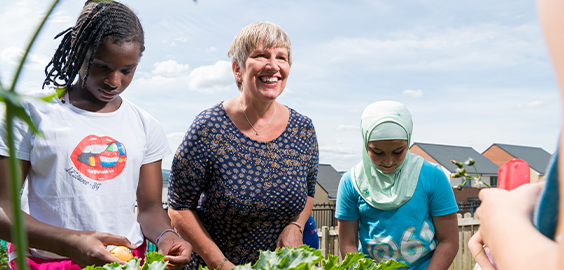
The disciplines of Social Work and Education all have moments of crossover, the similarities lie in community well-being, all of these fields focus on care and human development in some way, though there are unique qualities too.
When you study Social Work, you’ll have the opportunity to gain skills that help solve challenging and impactful situations, whether it’s helping a victim of abuse, empowering an elderly person to live independently, or helping a young person see their potential. Social workers impact some of the most vulnerable people in our society, it’s a challenging but rewarding degree that requires a passion for caring for people and supporting individual well-being.
Education degrees also focus on well-being, but in the context of learning. Teaching courses give you the tools and knowledge to bring out the best in young people through education.
What will I learn on a Social Work and Education course?
Social Work helps people in need. Whether they're struggling with addiction, mental health issues, poverty or abuse, social workers are there to help. When you study social work, you learn to provide vital services and support to those who need it most. Social Work courses develop your caregiving abilities and help us understand how to meet the basic needs of individuals, families, groups, and communities.
Education courses require an overview of social factors that Social Work focuses on. But the main focus for those who study Education is on how these factors affect young people’s learning development rather than social. If you study education, it’s likely that you want to be, or are a teacher. Teaching is an important and impactful job that requires you to share knowledge well, but also be mindful of personal and social development.
Facilities
As a Northumbria University student, you’ll have access to all the state-of-the-art facilities you’d expect at a top university; access to all the literature you need via the library or online collections, comfortable lecture theatres and tutorial rooms, study spaces to suit group work, individual and collaborative study as well as technology like PCs and laptops. When you study social work and education, you’ll also access the Coach Lane campus which houses industry-standard facilities and equipment related to education and social care.
Find out more and take a virtual tour of our Coach Lane campus facilities and see our campus maps.
Reputation
We’re proud of our reputation and our league tables speak for themselves.
Social Policy is ranked 3rd in the UK for research power in the UK out of 76 submissions (REF, 2021). This represents a rise of 15 places compared to 2014.
Education at Northumbria is ranked Top 20 in the UK by the Complete University Guide for 2025.
Education at Northumbria is ranked 4th in the UK for Graduate Prospects (Times Good University Guide, 2025). This is because over 97% of our graduates are in highly skilled employment or further study 15 months after graduation.
Research Excellence
Research at Northumbria University in The Department of Social Work, Education and Community Wellbeing is diverse, intersecting across many academic and professional disciplines and wider sectors of society. Broadly speaking, our research is guided by principles of social justice.
Research feeds teaching practice at Northumbria, and if you study Social Work you’ll be on the forefront of research in the field. This means that your training will be grounded in current, relevant research, future-proofing your degree.
Learn more about our ambitious research goals and real world impact.
Is Social Work like nursing?
Nursing and Social Work both call for a lot of similar skills, both degrees will train you to be an effective caregiver. But, where nursing is a medical profession, Social Work might be considered a social profession.
When you study Social Work, you’ll learn to offer support through your words, actions and knowledge about policy and resources rather than medical care.
Will I need to interview to study Social Work?
Many universities do require an interview as part of the admission process. Social Work is a demanding degree and requires integrity, ethics, emotional resilience, and commitment to helping others. The interview process helps universities determine whether or not your character meets the demands of the degree.
You can expect questions about your intentions about becoming a social worker, what you hope to achieve and why you’ve chosen the field. You may also be asked to talk about cultural and societal context affecting the field at the time of your interview and what impact you think this context has on the communities you will support.
Why do I need to choose the age range of the children I want to teach?
Most teaching qualifications are split into Early Years, Primary Education and Secondary Education.
Put simply, the learning outcomes for children at these different life stages require different strategies and practice. Specialist courses in early years education will likely be more focused on developmental milestones like speech and language. Primary education courses might focus more on grasping the basic skills and foundations of learning, reading, writing and numeracy. Secondary education tends to focus more on developing knowledge and skills in specific areas, secondary educators will also have more focus on preparing young people for life after school in work or further education.
Please Note
All content is accurate as of the time of writing, the information in this guide is subject to change and will be updated as required to reflect this.