
New Master Research Agreement strengthens commitment to cutting-edge research and innovation
Northumbria University and Lockheed Martin Space UK have signed a new Master Research Agreement,…

The Aerospace Medicine and Rehabilitation Laboratory was established to explore one of the most pressing challenges in human spaceflight: how the human body adapts to life beyond Earth. In microgravity, the absence of mechanical loading leads to rapid deconditioning of the musculoskeletal, cardiovascular and sensorimotor systems, particularly the leg and lumbopelvic/spinal musculature that plays a vital role in posture and movement. Over time, these changes can compromise astronaut health, performance, and safety, both in flight and upon return to Earth.
Our research investigates the mechanisms underlying these adaptations, using advanced physiological monitoring, biomechanical analysis, and simulated spaceflight environments. We aim to characterise how key tissue groups respond to altered gravity, inactivity, and unloading, and to identify strategies that maintain physiological health and performance across missions of varying duration and gravitational exposure.
We achieve the aims of our research through participation in major space-agency research campaigns and commercial human spaceflight missions, as well as through using our very own micro- and hypo- (reduced) gravity analogue facility, the Variable Gravity Suspension System (VGSS).
Originally, the lab’s work focused on post-flight lumbopelvic musculoskeletal reconditioning, helping astronauts regain normal musculoskeletal function following return to Earth. Over time, our focus expanded to include in-flight countermeasures - interventions designed to prevent deconditioning rather than simply reverse it. This shift reflects the needs of modern space exploration, where astronauts may spend months or even years in partial or microgravity environments on the International Space Station, lunar outposts, or future Mars missions.
One example of novel in-flight exercise countermeasures being developed by our Lab is blood flow restriction (BFR) exercise.
The Aerospace Medicine and Rehabilitation Laboratory is at the global forefront of the application of BFR exercise across both terrestrial and space contexts. Blood flow restriction exercise is a technique that uses carefully controlled partial occlusion of arterial blood flow to elicit musculoskeletal and cardiovascular adaptations under low external mechanical load.
This approach is designed to maximise physiological benefit while minimising volume, mass, and power requirements, and stress on environmental control and life support systems - critical factors in spacecraft design. We have also demonstrated efficacy in clinical rehabilitation and injury prevention on Earth, bridging the gap between space medicine and terrestrial health science.
The lessons learned from human adaptation to space environments extend beyond astronaut health. Our research has direct implications for clinical populations on Earth experiencing disuse, immobility, or neuromuscular weakness, such as people with low back pain or urinary incontinence, older adults with sarcopenia and associated comorbidities, individuals recovering from surgery, or those with neurological disorders. Through the translation of space-derived exercise concepts, the lab contributes to improved rehabilitation outcomes, demonstrating the mutual benefit of space-to-Earth innovation.

MAJOR RESEARCH CAMPAIGNS
Explore our contributions to international bedrest and parabolic flight campaigns, as well as our in-flight technology demonstrations

TECHNOLOGY INNOVATIONS
Learn about our pioneering Blood Flow Restriction exercise device for spaceflight and its dual-use potential

VARIABLE GRAVITY SUSPENSION SYSTEM
See how our globally unique space analogue platform enables micro- and hypo-gravity simulation for research and commercial testing

PARTNERSHIPS AND COLLABORATION
Meet our global network of agency, academic, and industry partners shaping the future of space health
COMMERCIAL AND TRANSLATIONAL IMPACT
Discover how we’re bringing space-derived innovations to market and building industry collaborations
MEET THE TEAM
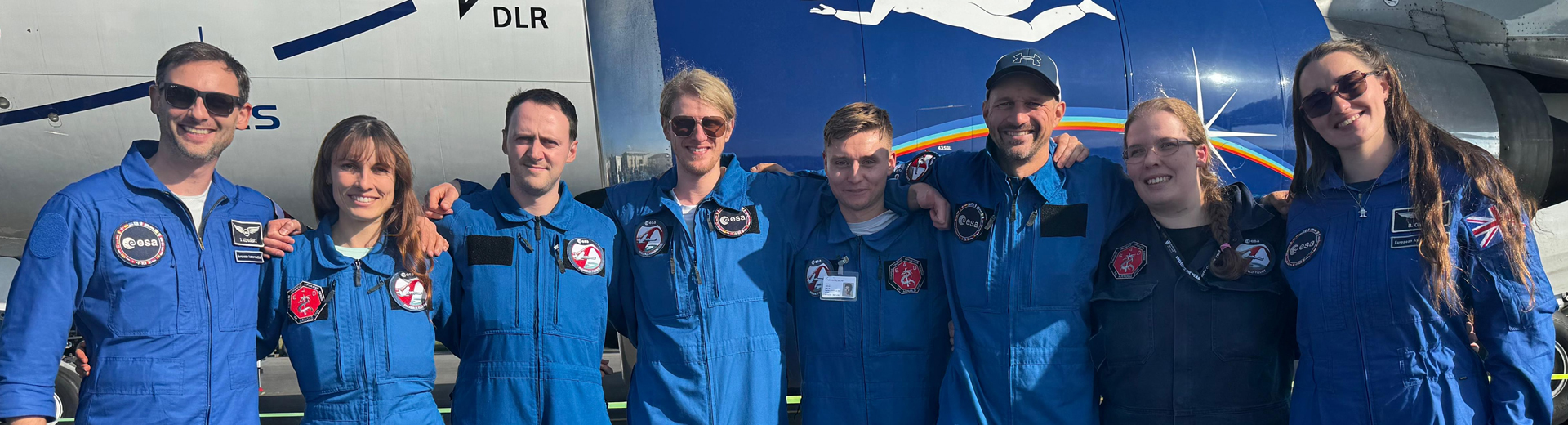
Meet the staff and students working in the Aerospace Medicine and Rehabilitation Laboratory

Northumbria University and Lockheed Martin Space UK have signed a new Master Research Agreement,…

The longest satellite record ever assembled shows that Greenland and Antarctica have lost 11.3…

Dr Juna Sathian, an Associate Professor at Northumbria University, has been elected a Fellow…

Northumbria University has played a key role in shaping a new national plan designed to help…

A Northumbria University academic, whose research has played a key role in bringing breakfast…

Wildfires raging through prehistoric rainforests helped create the earliest known peat bog…

A Northumbria University astronomer has helped uncover new clues about a rare icy object from…

Two leading academics from Northumbria University have been elected to the Fellowship of the…

Coach Lane Campus
-

Europa Hotel
-
The Great Hall, Sutherland Building
-
Manchester Marriott Hotel Piccadilly
-
Page last updated 26/05/26
