
I am a political and cultural geographer focusing on feminist and queer geopolitics and the study of more-than-human worlds. My research takes an interdisciplinary approach to the study of the former Soviet Union and contemporary Eastern Europe.
I am a Research Fellow with the ESRC's UK in a Changing Europe (2022-2025), completing a project entitled 'Debordering Europe through the 2022 Ukrainian Refugee Crisis: Analysis of Responses in the UK, Poland and Romania'. Drawing on extensive fieldwork with displaced people, community leaders, and policymakers, the project examines how people in different communities mobilised to offer support that went beyond state-sponsored initiatives. The work traces how everyday practices and acts of solidarity, e.g. hosting, sharing, translating, and cohabiting, challenge conventional, state-centred geopolitics and security thinking.
My key contributions to 'Debordering Europe through the 2022 Ukrainian Refugee Crisis: Analysis of Responses in the UK, Poland and Romania' have included:
- Understanding more-than-human forced displacement from Ukraine
- Attending to and analysing accounts of displacement with non-human animal companions
- Developing more-than-human approaches to alter-geopolitics
I teach widely across the BA (Hons) Geography programme of study and the MSc Global Development and MSc Disaster Management and Sustainable Development programmes of study. I am the module lead for KE7004: Sustainable Development and KE7006: Health and Well-being in Disaster and Development.
I joined Northumbria University in 2018 to complete my PhD, which was fully funded by a competitive studentship. My doctoral research is informed by multi-site ethnography in Ukraine and interdisciplinary analysis of media, art, film, and television. The thesis mobilises intersectional feminist thinking and queer theories to advance geopolitical knowledge of Ukraine. Theoretically, it engages with the work of Mikhail Bakhtin in dialogue with an analysis of the symbolic, rhetorical, affectual, and intimate geopolitical body. The locus of the argument advances Bakhtinian thought to enable a nuanced and novel approach to the study of queer geopolitics; presenting ‘popular festive geopolitics’ as a lens on Ukrainian LGBTQ+ subjectivities and the bodily politics of the former Soviet Union. It is undergirded by an interest in spatial-temporal place and subjectivity making in the former Soviet Union as different and apart from the geopolitical West and is written in concert with decolonial literature that unsettles Western spatial-temporal hegemony.

PhD November 23 2023
Latest News and Features
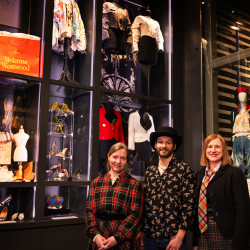
Northumbria University research unlocks the secrets of Vivienne Westwood's craft in a major new exhibition
A fashion researcher and educator from Northumbria University has created what is believed…
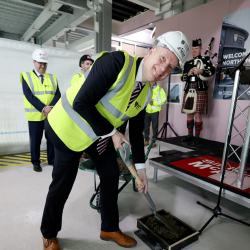
NESST topping out ceremony attendees receive traditional tankards to celebrate build milestone
Topping out ceremony marks pivotal moment for centre backed by £50 million investment set to…
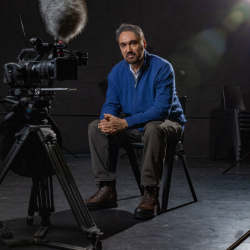
From Netflix to Newcastle Northumbria graduate uses AI to revolutionise film and TV production
A Northumbria University graduate who co-created Bangkok Breaking — one of Thailand's biggest…

Northumbria University researcher brings death-positive arts festival to libraries across England
An arts festival exploring death, dying and end-of-life choices — led by a Northumbria University…
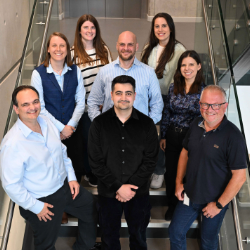
Northumbria University spinout achieves CE marking for deep lung breath sampling device — a first backed by peer-reviewed research
A medical device company spun out of Northumbria University has reached a significant milestone…

Northumbria University's IT recycling initiative recognised as national best practice
The equivalent weight of one and a half double-decker buses' worth of IT equipment has been…
More events
Upcoming events

From sustenance to complete nourishment in a changing and uncertain climate
Ellison Building A, 001 (ELA 001)
-

Broken Bonds: New Perspectives on Marital Breakdown
The Great Hall
-

Smarter Supply Chains: Digital Innovation for Cost, Efficiency & Carbon
Northumbria University
-

Culture in Conversation: Rethinking Leadership & Organisational Practice
CCE1 Newcastle Business School
-
